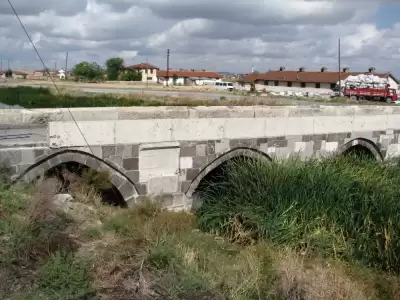
Dört Göz Bridge is an Ottoman-era stone bridge located over the Kali Stream in the Şuhut district of Afyonkarahisar. Its four-arched structure features two central arches wider than the side ones, reflecting the craftsmanship of its period with its round-arched architecture.
Located in the Hisar area, north of the Şuhut district, which is part of Afyonkarahisar province, the Dört Göz Bridge is one of the Ottoman-era stone bridges crossing the Kali Stream. The two central arches of its namesake four arches have wider openings compared to the side ones, providing both functional and aesthetic balance to the structure. Round arches and prominent arch ribs are among the most striking architectural elements of the bridge.
An important link in the region's historical transportation network, the bridge has connected the Şuhut plain with surrounding settlements for centuries. Today, the bridge offers visitors the opportunity to closely examine Ottoman stonemasonry and bridge architecture, and it is among Afyonkarahisar's lesser-known but valuable historical structures.
Guide's Note

Dört Göz Bridge, located outside Bolvadin district over the Akarcay, is a multi-arched historical bridge that has stood since the Byzantine period. Most visitors are impressed by the historical layers of the structure; the bridge bearing traces from the Byzantine, Seljuk, and Ottoman periods makes it a special point of interest for history enthusiasts. The prayer area added by Mimar Sinan and the spolia materials in the bridge's stones offer striking details when examined on site.
It is also a potential spot for photography: angles from the river flowing beside it and shots that can be captured during sunset hours have been particularly highlighted by multiple visitors. However, the disappointment regarding the structure being neglected and its value not being adequately preserved is also a frequently expressed issue in comments.
Before planning your visit, we recommend paying attention to the following practical points:
- Difficulty in access: Navigation apps sometimes give incorrect directions; you need to follow a rough road about 1.5 km long from the main road.
- Stray dogs: Multiple visitors have mentioned the presence of stray dogs in the vicinity; it is recommended to be careful when moving away from your vehicle.
- Lack of maintenance: The general condition of the structure has been observed to be neglected; it may be useful to shape your visit expectations accordingly.
History and Architectural Features of the Bridge
Dört Göz Bridge extends in a north-south direction over the Kali Stream in the Şuhut district of Afyonkarahisar. The structure, dating back to the Ottoman period, takes its name from its four-arched design. The two central arches are significantly larger than the side arches; this choice was likely made both to allow floodwaters to pass more easily and to add visual balance to the structure.
The most prominent architectural elements of the bridge are its round arches and arch ribs. These features, frequently encountered in Ottoman stone bridge tradition, directly reflect the period and construction technique of the structure. Built with local stones, the bridge has largely preserved its originality over centuries.
Best Time to Visit
The most suitable time to visit the bridge is during the spring and early autumn months. During these seasons, the water level of the Kali Stream rises, and the water flowing through the bridge's arches makes the structure much more impressive. For those who want to take photographs, early morning hours or the soft light of the afternoon best highlight the texture of the stone and the arch details.
During the summer months, due to Afyonkarahisar's continental climate, the weather can be quite hot; planning a visit in the early morning during this period provides a more comfortable experience. In winter months, the visual impact of the bridge may decrease as the stream's water level can recede.
How to Get There
Dört Göz Bridge is located in the Şuhut district, approximately 40 km from Afyonkarahisar city center. If you are going by your own vehicle, simply follow the Afyonkarahisar-Şuhut highway; after reaching Şuhut town center, the bridge is a short distance away.
For those preferring public transport, there are regular minibus services from Afyonkarahisar bus terminal to Şuhut. After getting off in Şuhut, it is possible to reach the bridge by walking or by a local vehicle. Since there is no designated parking area around the bridge, you may need to park your vehicle at a nearby spot.
Photography Spots
To get the best shot of the bridge, angles taken from the riverside are quite effective. Descending to the bed of the Kali Stream and finding a position that shows all four arches of the bridge simultaneously will allow you to capture all the architectural details of the structure in a single frame. Especially in spring, when the water is flowing, the reflections of the arches add a unique depth to the photograph.
In photographs taken from above the bridge, the wide panorama of the Şuhut plain can be used as a background. The light before sunset, known as the golden hour, accentuates the yellowish tones of the stone, giving the bridge a warm atmosphere. A wide-angle lens can be preferred for compositions that include all four arches.
What to Eat Nearby
In the local restaurants in Şuhut town center, you can find the main flavors of Afyonkarahisar cuisine. Afyon sucuk (spicy sausage) and pastırma (cured beef) are among the region's most famous products; it is possible to buy them fresh from butchers and delicatessens in the town center. For breakfast, the unique Afyon kaymak (clotted cream) and honey combination is indispensable.
If you combine your bridge visit with a tour of Şuhut district, you can fill your stomach with homemade dishes in the small artisan restaurants of the district. On your return to Afyonkarahisar city center, do not forget to taste local desserts such as katmer (layered pastry) and lokum (Turkish delight).
Suggested Itinerary: Şuhut and Surroundings
Instead of visiting Dört Göz Bridge alone, you can combine it with other historical and natural beauties of Şuhut district to create a half-day itinerary. You can set off from Afyonkarahisar in the early morning, visit the bridge first, and then explore Şuhut town center.
On your return route to Afyonkarahisar city center, you can also add prominent points of the city such as Afyon Castle, Ulu Mosque, and the historical bazaar area to your program. This way, you will experience both the tranquil historical texture of the district and the lively atmosphere of the city center on the same day.
Things to Know Before Visiting
Since the bridge is an outdoor historical structure, it can be visited in all seasons; however, keep in mind that roads may be slippery in winter. For those who want to descend to the stream bed, it is important to choose sturdy, non-slip shoes.
There are no facilities, cafes, or restrooms around the bridge; therefore, it is recommended to bring water and snacks with you. To avoid damaging the historical structure, climbing on the bridge stones and writing anything on the surfaces should be avoided. Leaving the area clean during your visit is of great importance for the preservation of this rare structure for future generations.
This content originates from neresigezilir.com.tr and may not be copied without permission.
Dört Göz Bridge Videos
Dört Göz Bridge videos load when you open this section to keep the page fast.
Show videos
FAQ

Updated: