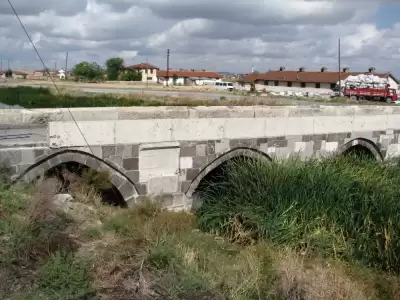
Rising over the Akarçay River in the northeast of Afyonkarahisar, Altıgöz Bridge is a six-arched Seljuk stone structure dating to 1209; it takes its name from its arch openings and is one of the city's important historical legacies with a history spanning over eight centuries.
Located in the northeast of Afyonkarahisar, near the railway station and at the foot of Cirit Kayası, the Altıgöz Bridge is a six-arched stone structure crossing the Akarçay River. According to the Arabic inscription on it, the bridge was completed before 1209; some sources state the construction date as H. 606 / M. 1209, noting that the construction was carried out during the period of Sabıküddin Ebül Vefa İlyas Bey, son of Oğuz. The bridge, mentioned in Akkoyunlu and Seljuk period sources, is considered one of the most concrete examples of Anatolian Seljuk architecture in the region.
Organically integrated into the urban fabric on Ali Çetinkaya Street, the bridge has played a critical role in Afyonkarahisar's trade and transportation life for centuries. The structure, notable for its cut stone masonry and pointed arch sequence, is today an important stop for both history enthusiasts and photography lovers.
Guide's Note
About Altıgöz Bridge
Altıgöz Bridge takes its name from its six arch openings. This simple yet impressive naming directly reflects the bridge's most distinctive architectural feature. The structure, crossing the Akarçay River, is located in the northeast of Afyonkarahisar, right at the foot of Cirit Kayası and near the railway station. Its organic integration into the city's historical fabric transforms it from an ordinary monument into a living piece of heritage.
The Arabic inscription on the bridge reveals that the structure was completed before 1209. Some sources state that the construction was commissioned by Sabıküddin Ebül Vefa İlyas Bey, son of Oğuz; the structure is considered one of the most important examples of Anatolian Seljuk architecture in the region. Built with cut stone material and a series of pointed arches, the bridge carries the engineering understanding of its era to the present day.
Historical and Architectural Significance
The construction date of the bridge, 1209, coincides with a period when Anatolia experienced intense construction activity under Seljuk rule. Bridges built during this period were not only crossing structures but also strategic points that ensured the security and continuity of trade routes. Altıgöz Bridge has protected this critical crossing over the Akarçay for centuries by serving its function.
The most striking architectural element of the structure is the series of six pointed arches lined up side by side. This form, frequently seen in Seljuk bridge architecture, offers a highly successful solution both aesthetically and functionally. The bridge, where cut stones were meticulously placed, has largely preserved its original form for over eight centuries; this clearly demonstrates the quality of the structure and the craftsmanship of its era.
Best Time to Visit
Since Altıgöz Bridge is an outdoor structure, it can be visited at any time of the year. However, the months of spring and autumn offer the most enjoyable experience, both in terms of weather conditions and the water level of the Akarçay. In spring, the river comes alive and the surroundings of the bridge turn green; this creates an ideal atmosphere for photography.
Visiting in the early morning hours is advantageous for both capturing the best light and experiencing a calm, crowd-free visit. In summer, it is recommended to choose morning or late afternoon to avoid the midday heat. While the bridge is accessible in winter, it should be noted that the surrounding ground may be slippery in rainy weather.
How to Get There?
The bridge is located on Ali Çetinkaya Street in Afyonkarahisar city center. It is possible to reach it on foot from the city center; it is approximately a 5–10 minute walk from Afyonkarahisar Train Station. If you are traveling by train, you can exit the station and reach the bridge directly with a short walk.
It is also quite easy to get there by dolmuş or taxi within the city. For those coming by car, it is possible to find parking in the vicinity; however, since it is in a central location, public transport or walking would be more practical. Including the bridge in a city tour itinerary along with other historical sites of Afyonkarahisar is also a good option.
Suggested Route: Afyon Historical City Tour
Altıgöz Bridge can be an ideal starting point for those who want to explore the historical texture of Afyonkarahisar. After visiting the bridge, you can walk towards Afyon Castle, the symbol of the city. In the historical neighborhoods at the foot of the castle, you can feel the layered history of the city step by step with Ottoman mansions and mosques.
You can create a complete city tour by adding the Ulu Mosque and its surrounding historical structures to your route. Don't forget to stop by the bazaar area at lunchtime to taste Afyonkarahisar's famous sucuk (spicy sausage) and kaymak (clotted cream). It is possible to complete this entire route at a comfortable pace within half a day to a full day.
Photo Spots
Altıgöz Bridge offers a highly photographic composition with the reflection of its six arches in the Akarçay water. For the most striking shots, try to go down to the riverbank and photograph the bridge from a low angle; this perspective reveals the arch sequence in all its glory.
Framing the bridge together with the silhouette of Cirit Kayası rising in the background allows you to obtain a powerful photograph reflecting Afyonkarahisar's unique geography. Since the morning light comes from the east, shooting from the west side of the bridge highlights the texture of the stones and the arch shadows. In spring, the greenery along the riverbank also adds vibrancy to the composition.
What to Eat Nearby?
Afyonkarahisar is one of Turkey's oldest gastronomic cities, and you can find opportunities to experience these flavors in the immediate vicinity of the bridge. The city's most famous product, Afyon sucuk, is a flavor recognized nationwide for its different consistency and spices. Additionally, Afyon kaymak stands out as a must-try delicacy, especially for breakfast.
In the restaurants in the city center, you can also find desserts with poppy seed paste and local pita varieties. In the bazaar area, a short walk from the bridge, there are both places where you can sit and eat and shops where you can buy sucuk and kaymak.
Things to Know Before Visiting
Altıgöz Bridge, being an outdoor historical structure, does not require a special entrance time or ticket; it can be visited freely at any hour. The bridge and its surroundings may have uneven ground; therefore, it is recommended to wear comfortable and sturdy shoes.
Since the structure is a registered historical monument, care should be taken not to damage its surroundings. It is important to be careful when descending to the riverbank, especially in rainy weather, keeping in mind that the ground may be slippery. Wheelchair and stroller use may be difficult due to the ground structure around the bridge.
This content originates from neresigezilir.com.tr and may not be copied without permission.
Altıgöz Bridge Videos
Altıgöz Bridge videos load when you open this section to keep the page fast.
Show videos
FAQ

Updated: