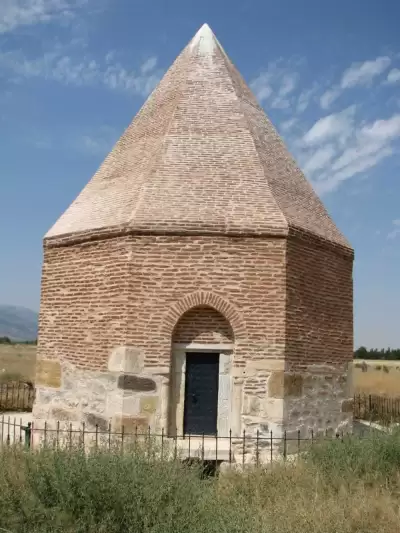
The Ebheri Tomb is a 13th-century Anatolian Seljuk period structure located in Eber town, part of Afyonkarahisar's Çay district; its octagonal body is built with stone and brick masonry, and it is open to visitors free of charge.
The Ebheri Tomb is an Anatolian Seljuk period structure located within a cemetery in the town of Eber, part of Afyonkarahisar's Çay district. This tomb, built in the name of Esirddin Ebheri, one of the renowned scholars of the period, dates back to the second half of the 13th century. Ebheri completed his initial education in Mosul, then traveled to Khorasan and Baghdad, becoming one of the leading scholars of his time.
The structure stands out with its octagonal body and the use of mixed materials: the lower section consists of stone walls, while the upper section is made of brick masonry. As one of the rare examples of Seljuk tomb architecture in the region, the structure is a worthwhile stop for its architectural and historical value. Also known as Eber Dede, this tomb holds spiritual significance for the local people.
Guide's Note
About Ebheri Tomb
Rising in a quiet corner of Eber town's cemetery, this tomb, though modest at first glance, reveals all the subtlety of Anatolian Seljuk stone and brick masonry upon closer inspection. Adhering to the tomb tradition of its period with its octagonal plan, the structure was built using stone in its lower section and brick in its upper section. The combined use of these two materials reflects the aesthetic and functional concerns of Seljuk architects.
The tomb was built for Esirddin Ebheri, after whom it is named. Ebheri was educated in Mosul, Khorasan, and Baghdad, and was among the important scholars of his time. Known as Eber Dede among the local people, this structure carries spiritual value beyond being merely an architectural heritage.
When to Visit?
The most suitable times to visit the Ebheri Tomb are spring and autumn. In April-May, the surroundings turn green, and the air temperature is suitable for sightseeing. In September-October, with the softening of summer heat, the region offers a more comfortable visiting experience.
During summer months, staying outdoors for long periods under the harsh sun of Central Anatolia can be tiring; therefore, it is recommended to plan summer visits for early mornings or late afternoons. In winter months, the dirt roads leading to the structure can become muddy, so choosing a high-clearance vehicle will make your journey easier.
How to Get There?
The most practical way to reach the Ebheri Tomb is by private car. Follow the sign for Eber village at the 58th kilometer of the Afyon-Konya highway; from there, the distance is approximately 4 km.
Those wishing to come by public transport can first reach Çay district center, then consider minibuses or taxis operating to Eber town. Regular bus services are available from Afyonkarahisar city center to Çay. Once in the town, the tomb is easily found within the cemetery area.
Photo Spots
The Ebheri Tomb is a simple yet powerful photographic subject. The corner details of the octagonal body and the texture of the brickwork offer rich material for close-up shots. In the morning, the light coming from the east accentuates the play of shadows on the stone surface, giving the structure a three-dimensional depth.
The general atmosphere of the cemetery area, along with the natural elements surrounding the tomb, can yield impressive results in wide-angle frames. Especially in spring, the contrast between the stone and brick texture and the surrounding greenery allows you to capture beautiful shots with natural light. We recommend walking slowly around the structure to document it from different angles.
Things to Know Before Visiting
Since the tomb is located within a cemetery area, it is important to maintain a quiet and respectful demeanor during your visit. It is recommended to check on-site whether entry into the structure is permitted, as conditions may vary.
As Eber town is a small settlement, finding restaurants or cafes nearby might be difficult; it is advisable to carry water and a light snack with you. A section of the road from the highway to the town might be unpaved; careful driving may be required in rainy weather. You can combine your visit with other historical and cultural sites in the Çay district for a more productive day.
Suggested Itinerary: Çay and Surroundings
Instead of planning the Ebheri Tomb as a standalone stop, combining it with cultural sites in and around the Çay district will make your visit much more meaningful. Starting from Afyonkarahisar city center, you can first visit the Çay district, then proceed to Eber town to visit the tomb.
Due to its location on the Afyon-Konya route, the tomb is a stop that can easily be added to the itinerary of those traveling between these two cities. For those who wish to complete the historical fabric of Afyonkarahisar, Karahisar Castle, maret Mosque, and Mevlevihane in the city center are also important points that can be visited on the same day.
What to Eat Nearby?
As Eber town itself is a small settlement, dining options are quite limited. For a broader gastronomic experience, Çay district center or Afyonkarahisar city center should be preferred.
Afyonkarahisar is one of Turkey's important gastronomic cities. Afyon sucuk (spicy sausage) and pastırma (cured beef) are among the most recognized delicacies nationwide. In addition, the combination of clotted cream and honey, various types of Turkish delight, and pişi (fried dough) are prominent flavors of the region. In local restaurants in the Çay district, it is also possible to find a simple and satisfying meal based on home-cooked dishes.
This content originates from neresigezilir.com.tr and may not be copied without permission.
Ebheri Tomb Videos
Ebheri Tomb videos load when you open this section to keep the page fast.
Show videos
FAQ

Updated: