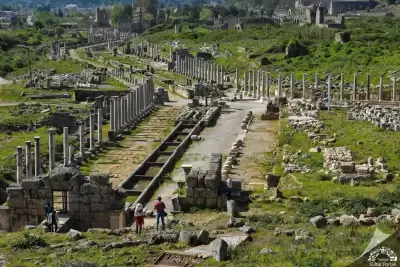
Trysa is an ancient Lycian city located near Kaş district in Antalya; the relief frieze panels of the 4th-century BC Heroon structure are renowned in the archaeological world, but the original friezes were transported to Vienna in 1882.
Trysa is a small but highly unique ancient Lycian city built on the eastern slope of a steep plateau, right near Davazlar village on the Kaş-Kale road. The city's name does not appear in any known ancient sources, making it one of Lycia's most mysterious and least documented settlements. The region was largely left to its own devices until it attracted the attention of European researchers in the 19th century.
The main element that brought Trysa to the world archaeological agenda is the monumental tomb structure found here, known as the Heroon. Dating back to the 4th century BC, the relief frieze panels surrounding this structure depict mythological scenes and battle illustrations in great detail. However, these frieze blocks were removed by Austrian researchers in 1882 and transported to the Kunsthistorisches Museum in Vienna. Today, only the stone foundations of the structure and a few architectural remains can be seen on site. The absence of the original frieze is both a disappointing and thought-provoking historical fact for visitors.
Nevertheless, Trysa continues to be an interesting stop for those seeking a tranquil ancient city experience away from mass tourism, with its Lycian rock tombs, remains of city walls, and secluded nature. The surrounding pine forests and high plateau landscape transform the visit from a mere archaeological trip into an exploration intertwined with nature walks.
Guide's Note

Trysa Ancient City, located about 3 km inland from the main road, is not large in scale but is a historical site that the vast majority of visitors enjoy. Rock tombs and the amphitheater are among the most prominent structures; you can get a close look at the arches and decorations of the theater. Visitors often express their surprise at seeing the traces of a settlement built in such a high and challenging geography.
The general level of preservation of the area is positively received; multiple visitors state that the city is well-preserved. Considering that temperatures can be quite high in summer, it is recommended to plan your visit for the early morning hours.
- Maintenance deficiencies: One visitor reports that some stairs and sections are poorly maintained to a degree unworthy of the Directorate of Museums.
- Entrance fee and duration: A comment points out that the fee paid (approximately 13 Euros) is not proportionate to the time spent in the area (around 15 minutes); therefore, it may be useful to evaluate in advance how much time you can allocate to the site.
- Restoration doubt: The same comment questions whether some structures might not be original but rebuilt; there is no definitive information on this matter.
Best Time to Visit
The best time to visit Trysa is during April-May and September-October. During these months, the temperature on the plateau is not oppressive, the pine forests are green, and the paths to the village are more comfortable to walk. In July-August, temperatures rise significantly; those wishing to visit during these months should choose the early morning hours, preferably shortly after sunrise. In winter, the paths can be muddy and slippery; visits between December-February are not highly recommended.
How to Get to Trysa?
The most practical way to reach Trysa is by renting a car or arranging a private tour from Kaş center. If you are departing from Antalya, you need to follow the D400 highway to Kaş, and then switch to the Kaş-Kale road. As you approach Davazlar village, look for signs directing you to the ancient city. From the village, the path takes about 30-45 minutes; sturdy, closed-toe shoes are essential. While it is possible to reach Davazlar from Kaş by minibus or dolmuş, schedules are irregular, and finding a return vehicle can be difficult.
What to Eat Nearby?
There are almost no dining options immediately around Trysa. We recommend purchasing food and drinks from Kaş center before your visit. Kaş is home to some of Turkey's best fish restaurants; fresh seafood, olive oil appetizers, and the light flavors of Mediterranean cuisine stand out here. Don't forget to bring plenty of water and light snacks for your long walk.
Where to Stay?
The closest accommodation option to Trysa is Kaş town center. Kaş offers a rich variety of boutique hotels, guesthouses, and holiday villages. You can find both budget-friendly and high-end options. A day trip can also be planned from Kemer or Antalya city center; however, in this case, the travel time will be quite long. Staying one night in Kaş allows you to comfortably explore both Trysa and other nearby Lycian ruins.
Photo Spots
The most interesting spots for photography in Trysa are the stone foundations of the Heroon and the architectural pieces remaining in place around it. Although much of the frieze is no longer on site, the remaining stone blocks and rock tombs create powerful compositions. When you ascend to the plateau, the pine forest and valley view stretching behind also provide a worthy background for photos. Morning light best brings out the texture of the stones; set off early for the golden hour.
Things to Consider Before Visiting
Trysa is not an archaeological site with developed infrastructure. There is no official visitor center, cafeteria, or restroom. The path is uneven and partly unclear; it is essential to bring sufficient water, sunscreen, and sturdy walking shoes. Be aware that most of the Heroon frieze is exhibited at the Kunsthistorisches Museum in Vienna; only foundation remains can be seen on site. Nevertheless, the historical importance and secluded atmosphere of the area create a highly satisfying experience for a conscious visitor.
Suggested Itinerary: Following the Lycian Trail
Instead of visiting Trysa alone, you can create a Lycian itinerary by combining it with other Lycian ruins in the vicinity. Start from Kaş center, visit Trysa in the morning, then proceed to Kekova and Simena. The next day, head to Demre for Myra Ancient City and St. Nicholas Church. This route allows you to see different facets of the Lycian civilization together; it offers an opportunity to get to know the region in depth rather than superficially.
This content originates from neresigezilir.com.tr and may not be copied without permission.
Trysa Ancient City Videos
Trysa Ancient City videos load when you open this section to keep the page fast.
Show videos
FAQ

Updated: