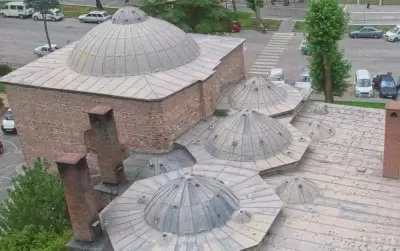
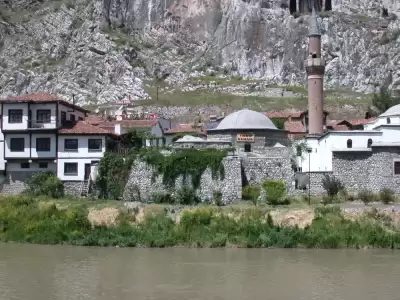
Yakup Pasha Çilehane Mosque is a Halveti Dervish Lodge built by Yakup Pasha during the reign of Sultan Mehmed Çelebi in 1413, located opposite the Royal Rock Tombs in Amasya. The structure, featuring classical Ottoman architecture, is actively used as a mosque today, and entry is free.
Çilehane Mosque (Mosque of Seclusion Cells) takes its name from the small cells within it. Built in 1413 by Yakup Pasha, one of the commanders of Çelebi Mehmed, the structure was not originally designed as a mosque: it was built as a Halveti Dervish Lodge. The seclusion rooms, where dervishes withdrew from the world for a certain period to discipline their souls, along with the prayer room and tomb, come together to form a single-domed structure.
Upon entering through the large, pointed-arch, cut-stone iwan gate on the west side, you'll find the prayer room and seclusion cells accessible via narrow passages on the right, and the tomb and dervish lodge section on the left. Most visitors describe this partitioned structure as a mosque form they haven't seen before. Inside is the tomb of Sheikh Abdurrahman, and outside, to the west, is the tomb of Yakup Pasha. The building, severely damaged in the 1939 earthquake, was repaired by the General Directorate of Foundations in 1964.
The structure is located on the foothills of Mount Harşena, within a neighborhood of old Amasya houses. It is within walking distance of the city center. The mosque is still actively used for congregational prayers. Above it, there is an area called Pirler Park, which functions as a tea garden and restaurant.
Guide's Note

Yakup Pasha Çilehane Mosque, built in 1413 during the Ottoman period, is a unique structure carved into the rocks at the foothills of Mount Harşena in Amasya. Visitors emphasize that the most intriguing aspect of the place is its small, dimly lit seclusion rooms inside; these cells were historically used by dervishes for retreat and worship. The structure combines a seclusion cell area, dervish lodge, dhikr area, and prayer space. Today, it continues to serve as an active mosque, where congregational prayers are held, and it is also preferred for i'tikaf (spiritual retreat).
Inside the mosque is the Tomb of Sheikh Abdurrahman, and in the garden, within a separate structure, is the Tomb of Yakup Pasha. The garden features old trees and seating areas; there is also a section for women. The structure, within walking distance of the city center, is located just below Pirler Park. The vast majority of visitors to Amasya consider this place one of the city's most striking historical and spiritual points.
While all existing reviews are positive, we recommend considering the following before your visit:
- The structure is located at a high elevation and has narrow passages; access may be difficult for those with mobility limitations.
- The seclusion rooms inside are quite small and dim; those who feel uncomfortable in enclosed spaces should consider this.
- There are no complaints regarding cleanliness, maintenance, or management in the reviews; however, as the number of reviews is limited, this situation may not always apply.
The Story of the Structure
Çilehane Mosque was built in 1413 by Yakup Pasha, one of the commanders of Çelebi Mehmed. Although known as a mosque today, it was originally a dervish lodge: it consists of seclusion cells used by dervishes for worship, contemplation, and self-discipline. The body walls are built with rubble stone and brick courses, and the windows have marble frames and brick arches. It was severely damaged in the 1939 earthquake and restored to its current state by the General Directorate of Foundations in 1964.
What to See Inside
Upon entering from the west gate, on the right are the prayer room and the seclusion cells reached by small passages; on the left are the tomb and the dervish lodge section. The tomb of Sheikh Abdurrahman is in a separate section inside the mosque, while the tomb of Yakup Pasha is outside on the west side. Visitors describe this partitioned structure as a mosque they haven't seen before; the small study rooms and i'tikaf cells are particularly noteworthy.
Suitable Time for Visiting
As it is an active place of worship, hours outside of prayer times are quieter. Fridays may be busy with congregational prayers; some visitors prefer to perform Friday prayers here. For those who want to take photos, daytime hours better showcase the light in the interior.
How to Get There
It is close to Amasya city center, in Mehmet Paşa Neighborhood. It takes about 10 minutes to walk from the square. It is located on an elevated point on the eastern side of the city, at the foothills of Mount Harşena; the road is a bit uphill.
What's Around
Above the mosque is Pirler Park; this area, used as a tea garden and restaurant, is a good stop for the continuation of your trip. The surrounding neighborhood consists of streets that preserve Amasya's old residential texture; you also get the chance to see these historic houses while walking around the mosque.
Things to Note When Visiting
As it is an active place of worship, it is necessary to wear modest clothing and remove shoes. It is important not to disturb the congregation during prayer times. There are tomb sections inside; it would be appropriate to be quiet in these areas.
How Much Time to Allocate
The structure itself is small-scale; 20-30 minutes is enough to explore the interior and the seclusion cells. If you wish to have tea at Pirler Park, you can extend the duration up to an hour.
This content originates from neresigezilir.com.tr and may not be copied without permission.
FAQ
Yakup Pasha Çilehane Mosque videos load when you open this section to keep the page fast.

Updated: