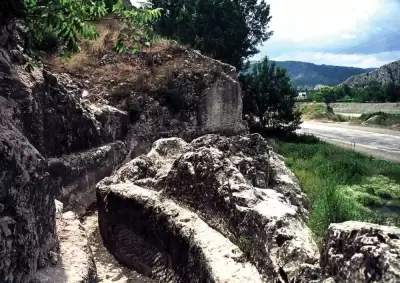
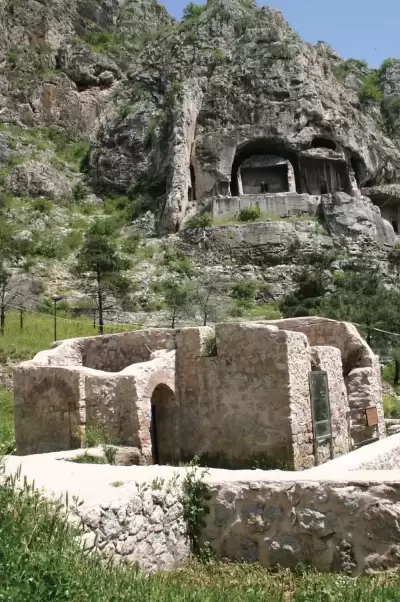
The Amasya Pontus King Rock Tombs are monumental tombs belonging to five kings from the Pontus Kingdom period, carved into the cliffs of Mount Harşena starting from the 3rd Century BC, and are on the UNESCO World Heritage Tentative List.
Considered among Amasya's most iconic structures, the Pontus King Rock Tombs were carved into the steep rock face of Mount Harşena, north of the Yeşilırmak River, starting from the 3rd Century BC during the Pontus Kingdom period. This area, containing the tombs of five kings, from the founder King Mithridates I Ktistes to Pharnaces I, is an open-air monument showcasing ancient stonemasonry and the understanding of death. With facades reaching up to 15 meters in height, the tombs create a silhouette that greets the city from every point.
Mount Harşena and the Pontus King Rock Tombs were added to the UNESCO World Heritage Tentative List in 2015. There are walking trails and viewing terraces arranged for visitors in the region; this allows you to examine the architectural details of the tombs up close and enjoy a bird's-eye view of Amasya's historical fabric and the Yeşilırmak valley.
Guide's Note

The Pontus King Rock Tombs are a historical site that significantly contributes to Amasya's skyline. The rock-carved tombs offer an impressive view, especially when considered together with the Yeşilırmak River and the Yalıboyu Houses. Visitors note that the evening lighting significantly enhances the view; however, keep in mind that this illumination may not always be active.
It is possible to climb close to the tombs; this allows you to examine the structures up close and view the city from above. Nevertheless, some visitors find that viewing from a distance is also sufficiently satisfying.
- Strenuous stair climb: Reaching the highest point requires climbing quite a lot of stairs; some visitors find this tiring.
- No entry inside: You can go up to the entrance of the tombs; entry into the interior is not possible.
- Entrance fee: Several visitors find the entrance fee unnecessary given that only exterior access is provided.
Best Time to Visit
Due to Amasya's mountainous location, summer months can be quite hot; you might encounter oppressive heat during the climb in mid-July and August. April, May, September, and October are the most balanced periods in terms of both weather and crowds. Although the tombs are open in winter, the risk of ice on rocky paths should be considered.
If you arrive in the early morning, especially at opening time, you can explore the area almost alone. On the other hand, in the evening, the golden light falling on the tombs is extremely impressive for both photography and atmosphere. When the night illumination is on, the rock-carved facades appear to hang over the city when viewed from the Yeşilırmak riverbank.
How to Get There
Amasya city center is easily accessible by bus, minibus, or private car. It is approximately a 4–4.5 hour drive from Ankara and about a 2-hour drive from Samsun. After arriving in the city center, you can reach the entrance of the tombs in 10–15 minutes by following the stepped stone path behind the Yalıboyu Houses.
For those arriving by car, paid parking options are available in the city center; it is not possible to reach the immediate vicinity of the tombs by car. There are also taxi and dolmuş (shared taxi) lines within Amasya. It is recommended to wear comfortable, non-slip shoes during the climb; some steps are steep and have stone surfaces.
Photo Spots
The Royal Rock Tombs are one of Amasya's most iconic photographic subjects. From the Yeşilırmak riverbank, especially from the bridges, the tombs, Yalıboyu Houses, and Mount Harşena come together in a single composition. During the day, the play of shadows on the rocky facade highlights the texture.
When you climb to the tombs, you can get wide-angle shots of the Amasya city center and the Yeşilırmak valley from the viewing terraces. For those who want to take night shots, the hours when the illumination is active offer a golden opportunity; it is possible to capture the reflection of the river and the illuminated silhouette of the tombs in the same frame with long exposure. In foggy weather in the morning, the mist rising from the foot of the mountain creates a dramatic atmosphere.
What to Eat After Your Visit
After descending from the tombs, tea gardens and small cafes await you in the Hatuniye Neighborhood, where the Yalıboyu Houses are lined up. Among the prominent flavors of Amasya cuisine are desserts and jams made with Amasya apples, bazlama with walnuts or cheese, and local lamb stews.
In the bazaar area of the city center, you can try local delicacies such as Amasya mantısı (dumplings) and tarhana soup in established restaurants. Restaurants along the Yeşilırmak riverbank offer pleasant options for both food and scenery; dining while watching the reflection of the tombs is a unique experience.
Suggested Itinerary in Amasya
For those who want to explore Amasya in a single day, the suggested itinerary can be structured as follows: Start early in the morning with the Royal Rock Tombs; this way, you avoid crowds and get to see Amasya in the morning light when you climb up. From there, descend and continue walking along the Yalıboyu Houses.
Before noon, you can visit the Amasya Museum and the Museum of Princes. After lunch, explore the Hatuniye Mosque, Burmalı Minare (Spiral Minaret), and the bazaar area. In the evening, returning to the Yeşilırmak riverbank to watch the illuminated tombs with their river reflection would be a beautiful conclusion. Visitors with two days can plan to climb Harşena Castle and explore the surrounding villages on the second day.
Things to Consider Before Visiting
The path leading to the tombs is steep and has stone steps; comfortable, non-slip walking shoes are essential. Wheelchairs or strollers cannot be used in this area. Elderly visitors or those with mobility limitations are advised to assess the climb beforehand.
In summer months, it is important to carry a hat and plenty of water to prevent sunstroke; shaded areas are very limited during the climb. Since entrance fees and Museum Card validity can change from time to time, it is useful to confirm current information from official sources before your visit. Be aware of staff instructions as flash photography may be restricted inside the tomb chambers.
Historical Background
The Pontus Kingdom ruled a vast geography extending from the Black Sea coasts to inner Anatolia between 333 BC and 44 BC. Amasya (ancient name Amaseia) was an important political and cultural center as the capital of this kingdom. The tombs carved into the northern slope of Mount Harşena reveal the importance the royal family placed on the afterlife and their mastery in stonemasonry.
Located in the Kızlar Sarayı (Maidens' Palace) area of Harşena Castle, the tombs of five kings reflect the influence of Hellenistic period architecture with column and cornice motifs on their facades. Some of the tomb chambers are open to visitors, where horizontally carved sarcophagus niches can be seen. The region, along with Amasya Castle, was added to the UNESCO World Heritage Tentative List in 2015.
This content originates from neresigezilir.com.tr and may not be copied without permission.
Amasya Pontus King Rock Tombs Videos
Amasya Pontus King Rock Tombs videos load when you open this section to keep the page fast.
Show videos
FAQ
Updated: