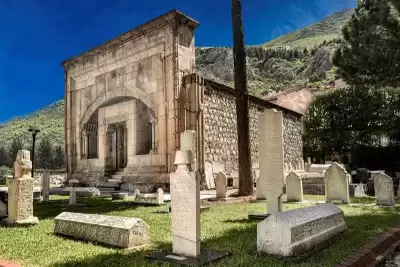
The Sultan Mesut Tomb is a 12th-century Anatolian Seljuk tomb located in the garden of Amasya Museum. The single-domed structure built with regular cut stones belongs to Seljuk Sultan Mesud I.
Located in Üçler Neighborhood of Amasya, in the garden of Amasya Museum, the Sultan Mesut Tomb bears one of the important traces of Anatolian Seljuk architecture in Amasya. Estimated to have been built in the 12th century, the structure draws attention with its single-domed architecture built with regular cut stones. Since the tomb does not have a construction inscription, its ownership was a subject of debate for a long time; however, the first written information was conveyed by Mustafa Vazıh Efendi, an Amasya historian who lived in the late 18th century, stating that the structure belonged to Seljuk Sultan Mesud I.
Today, the tomb is open to visitors in the garden of Amasya Museum. The structure, evaluated within the museum, is among the frequented spots for every history enthusiast visiting Amasya, along with other Seljuk and Ottoman works that form the city's historical fabric. Within this rich urban fabric consisting of riverside mansions along the Yeşilırmak, rock tombs, and numerous historical mosques, the Sultan Mesut Tomb stands as a silent but impressive witness carrying the traces of the Seljuks to the present day.
Guide's Note
Best Time to Visit
Any season is suitable for visiting the Sultan Mesut Tomb; however, spring (April–May) and autumn (September–October) offer the most pleasant period in terms of both weather conditions and surrounding greenery. Although temperatures rise in Amasya during summer, there are shaded areas within the city's historical fabric where one can walk. Visiting in the early morning provides a great advantage for both avoiding crowds and taking photos in natural light.
How to Get There
Since the tomb is located in the garden of Amasya Museum in the Amasya city center, transportation is quite easy. It is approximately 5–10 minutes' walk from Amasya Train Station. Those arriving by intercity bus can reach the city center from Amasya Bus Terminal by dolmuş or taxi. The tomb can also be easily reached by following the historical walking route along the Yeşilırmak riverbank. For those arriving by car, limited parking is available in the vicinity; parking in nearby streets and walking might be a more practical option.
Suggested Route: Amasya Historical Center Tour
The Sultan Mesut Tomb is one of the most efficient stops to include in Amasya's historical center walking route. Visiting the tomb while visiting the Amasya Museum is the best way to use your time efficiently. After the museum visit, you can walk to the Yalıboyu Houses along the Yeşilırmak riverbank, and from there, climb up to the King Rock Tombs. During the day, you can also add structures such as the Büyük Ağa Madrasa, Burmalı Minare Mosque, and Bimarhane (Darüşşifa) to your route to explore Amasya's historical layers step by step.
Photo Spots
The Sultan Mesut Tomb offers interesting frames for photography enthusiasts with its simple and powerful architecture. The smooth cut stone surface and the silhouette of the single dome create an impressive view, especially in the morning light. It is possible to frame the tomb with its surrounding greenery from the museum garden. By preferring a wide-angle lens, it becomes easier to capture the entire structure and the historical atmosphere around it in a single shot. In close-ups of the tomb, the texture of the stone craftsmanship is also a detail worth documenting.
What to Eat Nearby
Amasya city center, where the tomb is located, is quite rich in local delicacies. Amasya apple is the most well-known product of the region and can be easily found at fruit stalls and souvenir shops. At restaurants and cafes along the Yeşilırmak riverbank, you can taste keşkek, tarhana soup, and local meatball varieties. Small artisan restaurants in the city's historical bazaar area can be a good choice for both an affordable and authentic dining experience.
Things to Know Before Visiting
The Sultan Mesut Tomb is located in the Amasya Museum garden, so the visit takes place with museum admission. Museum admission is charged; we recommend checking current information regarding the validity of museum cards before you go. Entry to the interior of the tomb may not be possible; the structure is examined from the outside. During the visit, general rules of the museum garden must be followed. Photography is generally allowed, but separate rules may apply inside the museum.
Historical and Architectural Significance
The Sultan Mesut Tomb is a structure believed to belong to the Anatolian Seljuk period and estimated to have been built in the 12th century. One of the most interesting features of the tomb is the absence of a construction inscription; this made the ownership of the structure uncertain for many years. Its association with Seljuk Sultan Mesud I was first documented by Amasya historian Mustafa Vazıh Efendi in the late 18th century. The structure reflects the characteristic features of the Anatolian Seljuk tomb tradition with its single-domed architecture built with regular cut stones. Its preservation in the Amasya Museum garden played a decisive role in the structure's survival to the present day.
This content originates from neresigezilir.com.tr and may not be copied without permission.
FAQ
Updated: