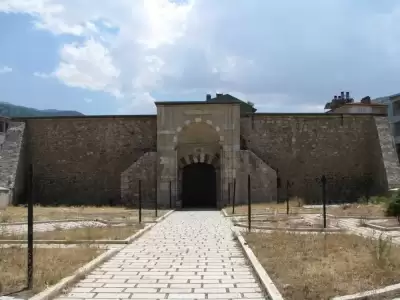
Çay Caravanserai is an Anatolian Seljuk caravanserai located in the Çay district of Afyonkarahisar, built by Gıyaseddin Keyhüsrev III in 1279; it carries the Silk Road heritage with its stone masonry adorned with a leopard emblem and its courtyard-enclosed plan.
Standing in the district center of Çay, Afyonkarahisar, the Çay Caravanserai is one of the most impressive examples of Anatolian Seljuk architecture that has survived to the present day. Built in 1279 by Gıyaseddin Keyhüsrev III, the structure is an original part of a complex where both courtyard and enclosed caravanserai types can be seen together. The leopard emblem and geometric decorations in its stone masonry give the structure an identity beyond its nickname, Taşhan (Stone Inn).
The structure, which opened its doors to Silk Road caravans for centuries, underwent a comprehensive restoration process completed in 2016 by the General Directorate of Foundations. Today, visitors can both breathe in history in this monumental space belonging to the Seljuk period stone complex and explore the local handicrafts bazaar. When considered together with the nearby Sultan Alaaddin Mosque and the historical fountain, the Çay district alone offers a small but satisfying historical tour.
Guide's Note
Located near the old square in Afyonkarahisar city center, Çay Caravanserai (Taşhan) is a point of interest for visitors with its historical structure dating back to the Seljuk period. The venue, which is said to be easily accessible, hosts a large number of visitors when open; basic refreshments such as tea and Turkish coffee are offered.
However, a large portion of visitors report serious difficulties in accessing the venue. Multiple people state that they found the door closed on different days and times or were not allowed in on the grounds that there was no event. Some visitors believe that such a deeply rooted historical structure should be utilized with a more permanent and accessible function, for example, as a museum.
We recommend paying attention to the following points before planning your visit:
- Uncertain opening hours: Multiple visitors found the venue closed, including during lunch hours; no clear information could be obtained about official opening and closing times.
- Event-dependent access: It has been reported that visitors are only admitted during events at certain times; if there is no event, entry is not permitted.
- Advance inquiry recommended: Visitors coming from afar or passing by may consider confirming whether the venue is open beforehand to avoid a wasted trip.
Best Time to Visit
The most enjoyable time to visit Çay Caravanserai is during spring and autumn. In April-May, the nature around Çay district comes alive; mild weather makes walking and spending time in the open courtyard easy. In September-October, with the end of the crowded tourist season, there is an opportunity to explore the structure in a calmer atmosphere. In summer, the heat of Central Anatolia can be quite oppressive; it would be wiser to plan a visit in the early morning hours during this period. Although the structure is open to visitors in winter, transportation conditions may need to be checked beforehand.
How to Get There?
To reach Çay district from Afyonkarahisar city center, intercity buses or minibuses can be preferred; services depart at regular intervals throughout the day. If you are coming with your own vehicle, follow the Afyon-Konya highway and you will reach Çay district center after approximately 55 km. Taşhan is located right in the heart of the district center, so it can be easily found on foot after parking your car. The nearby Sultan Alaaddin Mosque and historical fountain are also on the same walking route, so you can see the entire complex in one go.
History and Architecture
Çay Caravanserai was built by the Anatolian Seljuk Sultan Gıyaseddin Keyhüsrev III and completed in 1279. The structure has a mixed plan, combining both courtyard and enclosed caravanserai types. 12 columns are arranged around the square-planned structure; while the winter enclosed section has been largely preserved over centuries, the courtyard part has suffered damage over time. The leopard emblem on the facade is the most striking detail, showcasing the mastery of Seljuk stone craftsmen. Thanks to the restoration works completed by the General Directorate of Foundations in 2016, the structure today preserves its historical identity and opens its doors to visitors.
Photography Spots
Taşhan is a structure that offers photography opportunities at every corner. The stone masonry and leopard emblem at the main entrance gate provide a unique detail for close-up shots. Looking up from inside the courtyard, the frame formed by the Seljuk arches creates a backdrop for dramatic compositions. In the early morning hours or in the late afternoon sunlight, the texture of the stones gains depth; at these times, the play of light and shadow adds a distinct character to the structure. Wide-angle shots with the nearby Sultan Alaaddin Mosque also yield very impressive results.
What to Eat in Çay District?
Çay district offers all the flavors of Afyonkarahisar cuisine on a small scale. Afyon sucuk (spicy sausage) and pastırma (cured beef) are among the region's most well-known products; they can be obtained fresh from small butcher shops and grocery stores in the district. There are small places within the bazaar area of Taşhan where you can drink tea and coffee; it is an ideal option for a break in a historical atmosphere. If you are looking for a meal, you can try local dishes such as home-cooked meals and Afyon-style tirit at local restaurants in the district center.
Shopping: Local Products and Handicrafts
The handicrafts bazaar opened within Taşhan after restoration offers visitors the opportunity to buy local products directly from their source. The bazaar features hand-woven textile products, wood-carved objects, and souvenirs specific to Afyonkarahisar. Afyon's famous lokum (Turkish delight) and kaymak (clotted cream) can also be easily found in the region; vacuum-packed options offer a practical solution for those planning long journeys. Bargaining is possible in the bazaar shops; in the morning hours, the shops are quieter, making it much easier to chat with sellers and get information about the products.
Things to Know Before Visiting
Some parts of the structure have uneven and stone-paved floors; it is recommended to wear comfortable walking shoes instead of high heels or flat sandals. Wheelchair or stroller use may cause difficulties in the interior spaces of the structure. Since Çay district is a small settlement, do not expect large hotels or chain restaurants; it is more practical to use Afyonkarahisar city center as a base for accommodation. As visiting hours may change, it is advisable to inquire beforehand, especially during public holidays.
This content originates from neresigezilir.com.tr and may not be copied without permission.
FAQ
Çay Caravanserai (Taşhan) videos load when you open this section to keep the page fast.

Updated: