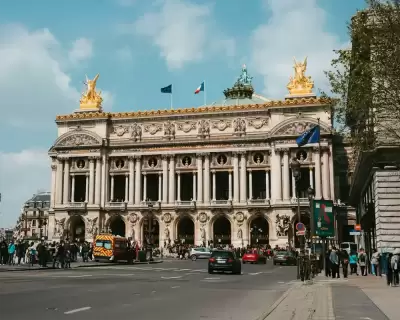
The Panthéon is a neoclassical mausoleum located in Paris's Latin Quarter, completed in 1790; it houses over 70 famous French figures such as Voltaire, Rousseau, Victor Hugo, and Marie Curie. The entrance fee for adults is approximately 11.50–13 Euros.
Located in the heart of the Latin Quarter, in Paris's 5th arrondissement, the Panthéon is a monumental structure that carries the collective memory of the French nation. Construction began in 1758 and was completed in 1790. The building was originally designed as a church dedicated to Sainte Geneviève, the patron saint of Paris. However, with the radical transformation brought by the French Revolution, it lost its ecclesiastical function and was converted into a national mausoleum, housing France's great intellectuals, scientists, writers, and statesmen.
Designed by architect Jacques-Germain Soufflot, the structure is considered one of the earliest and most successful examples of neoclassicism, with its colonnaded facade inspired by the Pantheon in Rome and its magnificent dome. The crypt on the lower level houses Voltaire, Rousseau, Victor Hugo, Émile Zola, Marie Curie, and many other historical figures. The building also displays a replica of Léon Foucault's famous pendulum, which he used in 1851 to prove the Earth's rotation.
Related discoveries: Things to do in Paris, Historical Sites, Historical sites in Paris, Saint-Étienne-du-Mont Church.
Guide's Note
What is the Panthéon, and Why is it Important?
The Panthéon appears as a magnificent neoclassical structure at first glance; however, once you step inside, you feel that it holds a meaning far beyond that. The building encapsulates the spirit of the French Revolution, the Enlightenment, and national identity under one roof. Voltaire, Rousseau, Victor Hugo, Émile Zola, and Marie Curie are buried here; each of these names has left deep marks in the intellectual history of France and the world.
The original design of the structure belongs to architect Jacques-Germain Soufflot. Soufflot blended the colonnaded facade of the Pantheon in Rome with the dome concept of St. Paul's Cathedral in London, creating one of the boldest architectural experiments of his time. Today, the Panthéon is not just a mausoleum; it is also the stage for French state ceremonies, national remembrance days, and symbolic gestures.
Best Time to Visit
The most suitable time to visit the Panthéon is during spring and autumn. In April-May and September-October, the weather is pleasant, and you can enjoy a calmer visit away from the dense tourist crowds of the summer months. In July and August, the structure can be quite crowded; during this period, going in the early morning significantly shortens waiting times.
Visiting on a weekday morning, especially outside of school holidays, offers the calmest visiting conditions. Purchasing a fast-track ticket is also a practical way to skip the queue. For observing Foucault's Pendulum, morning hours can be preferred; since the pendulum moves continuously throughout the day, it can be observed at any time, but the visual experience inside the dome is more impressive in the morning light.
How to Get to the Panthéon?
Reaching the Panthéon by public transport is quite easy. You can take the RER B line to Luxembourg station and walk for about 5 minutes to reach the building. For those preferring the metro, Line 10 Maubert–Mutualité or Cardinal Lemoine stations are also within walking distance. Many bus lines also stop near Place du Panthéon.
The structure is about a 5-minute walk from the Luxembourg Gardens; therefore, it is quite logical to fit both places into the same day. For those coming by car, the nearest paid parking is Soufflot-Panthéon parking; it is a 3-minute walk from there. A general reminder for central Paris: public transport is always a more practical option due to traffic and parking issues.
Visit Route and Sections to Explore
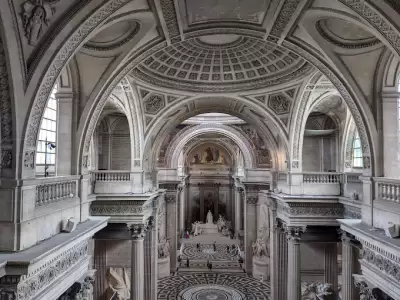
When visiting the Panthéon, you can explore several different layers. On the main entrance floor, you are greeted by the magnificent interior of the building: colossal columns, vaulted ceilings, and frescoes adorning the walls. Some of these frescoes depict scenes from French history and the life of Sainte Geneviève.
In or near the center of the space, you can see the replica of Foucault's Pendulum; this experiment, used by Léon Foucault in 1851 to prove the Earth's rotation on its axis, is one of the most striking moments in scientific history. Then descend to the crypt on the lower level: here, the tombs of Voltaire and Rousseau placed opposite each other, the memorials of Victor Hugo and Émile Zola, and Marie Curie's sarcophagus await you. Curie was the first woman to be buried here; this detail alone is thought-provoking. You should plan your visit for approximately 1.5 to 2.5 hours.
Photo Spots
The Panthéon is an extremely photogenic structure both from the outside and inside. A wide-angle photo taken from Place du Panthéon square captures the entire facade and colonnaded entrance of the building best. Photos taken in the early morning or late afternoon with soft light are particularly impressive.
Inside, photos taken looking up from under the dome are breathtaking; if you have a wide-angle lens, be sure to use it. In the crypt, a tripod or high ISO setting might be useful due to low light conditions. The tombstones of Marie Curie and Victor Hugo are also frequently photographed spots. Night photos taken from the square directly in front of the building also yield very successful results; the building is illuminated at night.
What to Eat and Where to Go Nearby?
The Panthéon is located right in the middle of the Latin Quarter, one of Paris's most vibrant and delicious neighborhoods. Before or after your visit, you can enjoy a French-style breakfast or lunch at the surrounding cafes. There are plenty of brasserie and bistro options on Rue Soufflot and the surrounding streets.
If you're willing to walk a bit further, the Rue Mouffetard market and its surrounding restaurants offer one of the most authentic dining experiences in the Latin Quarter. This street is full of bakeries, cheese shops, and wine stores frequently visited by Parisians. For an afternoon break, the cafe in the Luxembourg Gardens is both a practical and pleasant option.
Things to Know Before Your Visit
Keeping a few practical tips in mind before entering the Panthéon will make your visit easier. Purchasing a fast-track ticket allows you to skip long queues, especially during summer months and weekends; these tickets can be obtained in advance from various online platforms.
Visitors under 18 and EU citizens under 26 are entitled to free admission; in this case, you just need to show a photo ID at the ticket office. It is expected to be mindful of noise levels inside the building, especially in the crypt section, and to maintain a respectful demeanor. Large suitcases and backpacks can be left at the cloakroom. Photography is allowed, but flash use may be restricted; be sure to adhere to these rules inside.
Budget Planning
A visit to the Panthéon comes with a reasonable entrance fee compared to many museums in Paris. Adult admission ranges from approximately 11.50–13 Euros. Admission is free for visitors under 18 and EU citizens under 26. On some online platforms, Panthéon tickets are also sold in combined packages with other activities such as Seine River boat tours; these packages can offer cost advantages for those planning multiple activities.
Additionally, you can rent an audio guide or use guided tour applications downloadable to your smartphone. Dining establishments in the Latin Quarter offer a wide range of prices; for budget-friendly options, small bistros and bakeries around Rue Mouffetard would be a good choice.
FAQ

Updated: