The Turkish and Islamic Arts Museum is located in the 16th-century Ibrahim Pasha Palace in Sultanahmet, Istanbul, housing rare carpets and manuscripts from the Abbasid to the Ottoman periods.
The building is the palace that Suleiman the Magnificent had built for his Grand Vizier Pargalı Ibrahim Pasha, to whom he married his daughter in 1520. The fact that it is one of the oldest Ottoman structures, apart from imperial palaces, to survive to this day makes the museum interesting in itself. Inside, nearly 40,000 artifacts dating back to 661 CE are exhibited: 13th-century carpets from the Seljuk period, handwritten Qur'ans, examples of calligraphy, woodworks, and ceramics. The carpet collection is considered one of the richest in the world.
The museum opened in 1914 in the imaret building of the Süleymaniye Complex and was moved to its current location, the Ibrahim Pasha Palace in Sultanahmet Square, in 1983. It was restored in 2012 and reopened to visitors in 2014, on the 100th anniversary of its initial opening, with a new exhibition layout. In the courtyard section, there is an ethnography collection reflecting 19th-century Istanbul daily life, and in a separate section, a collection of Holy Relics similar to those in Topkapi Palace.
Visitors most often mention the building itself and the terrace overlooking Sultanahmet Square. You can enjoy the view of the Blue Mosque while sipping tea at the cafe. The visit duration is short, one to one and a half hours is sufficient, which makes it easy to fit into a Sultanahmet tour. There are comments that the ethnography section may be closed at certain times; you can inquire at the ticket office.
Related discoveries: Museums, Istanbul museums, Büyük Mecidiye Mosque (Ortaköy Mosque).
Guide's Note

Best Time to Visit
Since the museum is open every day, there is no problem choosing a day, but choosing the time is important. Going close to opening (between 09:00-10:00) avoids the crowds, because groups finishing their Sultanahmet tour in the afternoon visit the museum afterwards. Visiting the Blue Mosque and Hagia Sophia in the morning and then moving to this museum towards noon is a logical sequence. It offers both a chance to rest tired legs by sitting down and an opportunity to see the mosque again from the terrace cafe.
How to Get There?
For those coming from the European side, the most practical way is the T1 tram line. Take the Bağcılar-Kabataş line and get off at the Sultanahmet stop, then reach the museum in a few minutes on foot. If you are coming from Taksim, you can take the funicular to Kabataş and then transfer to the same tram. Those coming from Beşiktaş can take a bus or walk to Kabataş and continue. Those starting from Kadıköy or Üsküdar should first take a ferry to Eminönü, then reach Sultanahmet by tram. The museum is directly opposite the Blue Mosque, on the Hippodrome, so it's easy to find.
How Much Time Should You Allocate?
It is not a large museum; most visitors allocate between 1 and 1.5 hours. Since the labels are in Turkish and English, those who want to explore by reading can also fit it into this time. For those who want to explore without rushing and then sit on the terrace, 2 hours is more comfortable.
How to Add it to Your Sultanahmet Itinerary?
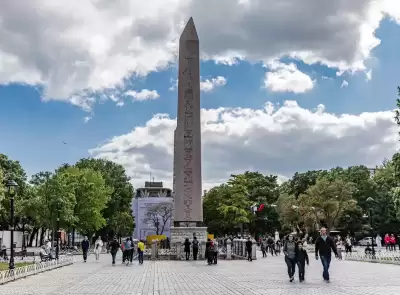
The museum is within walking distance of Hagia Sophia and the Blue Mosque, so it easily fits into a one-day Sultanahmet tour. Visiting Hagia Sophia in the morning, then the Basilica Cistern, the Blue Mosque at noon, and then moving to this museum across the square is a non-tiring sequence. After leaving the museum, you can also see the Obelisk and the German Fountain in the Hippodrome with a short walk.
Tickets and Museum Pass
Museum Pass is valid at this museum, so entry is free for cardholders. Those without a card can purchase one at the ticket office; some visitors state that the card fee is 100 TL. The full ticket price is listed as 875 TL in updated tariffs, but since this figure can change, it is advisable to confirm via muze.gov.tr before visiting.
Things to Pay Attention To
Only carbonated drinks are sold at the cafe in the courtyard; there are comments stating that water is not available. If you think you will get thirsty, it is a good idea to bring water with you. There are also comments that the ethnography section may be closed at certain times; you can inquire at the ticket office. The gift shop is small, so don't expect a large shopping experience.
Good Spots for Photos
The terrace in the courtyard offers the best shot of the Blue Mosque and the Hippodrome. The stone walls of the palace and the courtyard layout are also interesting for those who love architectural photography. Inside, the hall where the carpet collection is exhibited is strong from a photographic perspective, especially at times when the light hits the carpets.
FAQ
Updated: