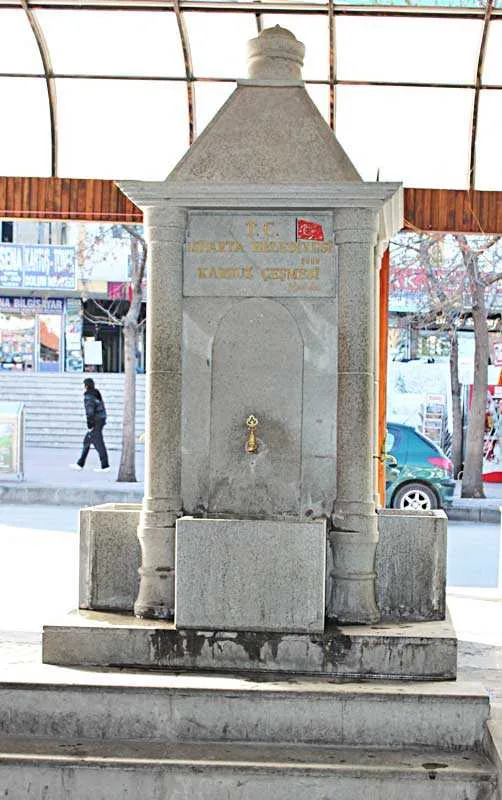
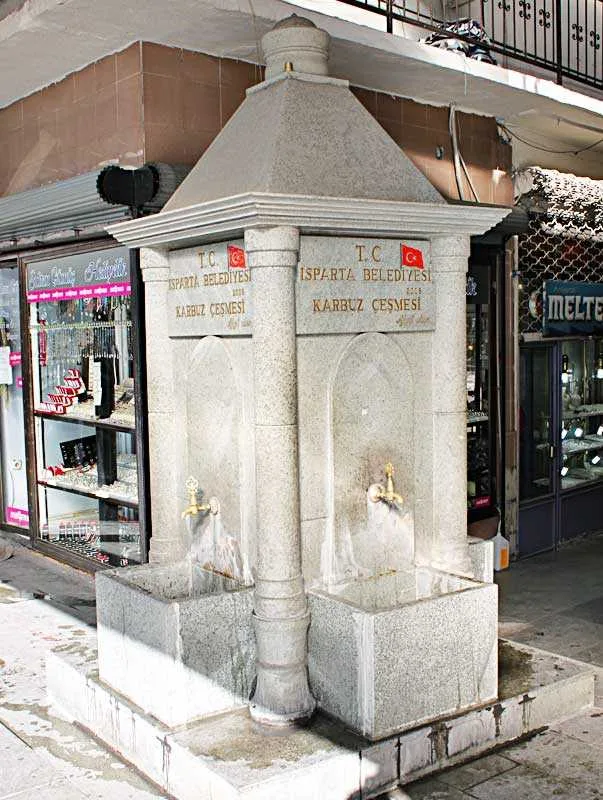
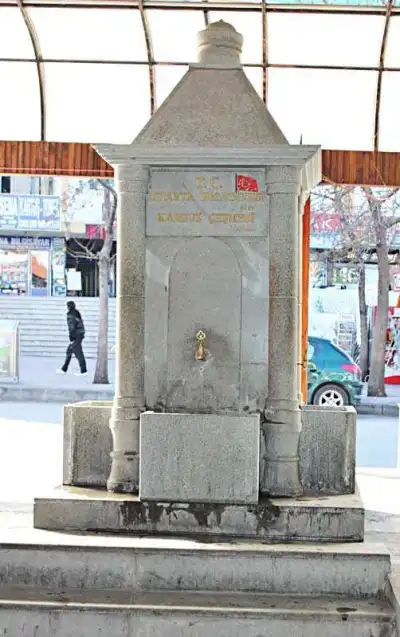
Karbuz Çeşmesi, Isparta merkez Mimar Sinan Caddesi'nde yer alan, 1768'den kalma dört yönlü mermer çeşme. Adı "kar-buz" (kar gibi soğuk su) anlamından gelmektedir ve 2019'da kendi kaynak suyuna yeniden kavuşturulmuştur.
Karbuz Cesmesi was built in 1768 (Hijri 1194) by Kececi Haci Mustafa Aga, who brought water to Isparta, on behalf of Halil Hamid Pasa. There was allegedly a quatrain on its inscription confirming this information, but today that inscription is lost. The fountain actually stood across from Mimar Sinan Mosque until 1945. Due to road construction, it was moved to its current location, and was last rebuilt in 1992 as marble with four taps on four sides.
The origin of the name is also a matter of curiosity. Contrary to common belief, it comes not from "watermelon" but from "kar-buz" (snow-frost). In the past, snow and frost dominated Isparta for eight months of the year, so water flowed ice-cold throughout the year. In 2019, the municipality laid a new 2,600-meter line from the Akyokus Spring in Yenice Neighborhood Andik. Thus, the fountain became independent of municipal water and reconnected with its own spring water. This development was reported in the local press with headlines like "legend returned."
The fountain carries traces of Isparta's old bazaar life. Together with the nearby Grape Market, it was once a meeting point where shoe painters, conversations, and friendships passed through. Today it remains a stop where those heading into the central bazaar cool off, integrated into the city's daily life.
Guide's Note
The Story of the Fountain
Karbuz Cesmesi was built by Kececi Haci Mustafa Aga on behalf of Halil Hamid Pasa. The costs were covered by Halil Hamid Pasa. The fountain once had an inscription bearing the date 1194 (Hijri), but this inscription was lost over time. Today, the real value the fountain holds is being one of Isparta's 18th-century water structures and becoming a symbol intertwined with the city's bazaar life.
Origin of the Name: Watermelon or Snow-Frost?
The fountain's name does not come from the watermelon fruit as many people think. According to local tradition, the name derives from 'kar-buz' (snow-frost). Because snow and frost once dominated Isparta for eight months of the year, water flowed ice-cold nearly throughout the year. Over time, the pronunciation changed to "karbuz," then to "watermelon" in common speech.
How to Get There
The fountain is located on Mimar Sinan Street in the center of Isparta. Thanks to its proximity to the city center, it can be seen on foot during a central bazaar tour without needing separate transportation.
How Much Time to Spend
The fountain itself is not a large structure, 5-10 minutes is sufficient. Its real value is being a natural rest stop when visiting Isparta's central bazaar and being easily added to a route.
How to Add to a Route
Karbuz Cesmesi is a natural part of an Isparta city center bazaar tour. Due to its proximity to Grape Market, it can be included in a walking route that combines historic structures and bazaar visits within the city. Mimar Sinan Mosque is also in the nearby area, so it can be seen as part of the same visit.
Water Source Changed
Until 2019, the fountain was connected to the city water network. Isparta Municipality laid a new 2,600-meter line from Akyokus Spring in Yenice Neighborhood Andik, reconnecting the fountain with its original spring water. This change received wide coverage in the local press and was welcomed by the public as "the legend returned."
For Photography
The four-sided, four-tap marble structure shows details clearly in close-up. Afternoon light makes the texture on the marble surface more prominent.
This content originates from neresigezilir.com.tr and may not be copied without permission.
FAQ
Updated: