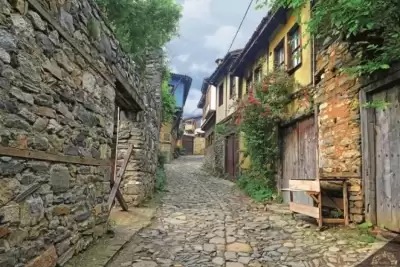
The Ottoman House Museum is a three-story building located in Bursa's Muradiye neighborhood, opposite the Complex of Murad II, built as a 17th-century pasha's residence; it showcases Ottoman living culture with its harem-selamlik sections and period furniture.
Standing directly opposite the complex of the same name in Muradiye, one of Bursa's historic districts, the Ottoman House Museum is one of the rare structures that greets you as soon as you step into the city's historical fabric. Believed to have been built in the 17th century as a pasha's residence, the building has a three-story plan, including a basement, ground floor, and first floor. Originally completely closed off from the street, this house has managed to preserve the most distinctive features of Ottoman civil architecture over time.
The museum showcases 17th-century Ottoman lifestyle with period furniture, everyday objects, and traditional interior arrangements. The harem and selamlik sections concretely convey how the house functioned during that era. This location, surrounded by the Muradiye Complex, Muradiye tombs, and the Tophane district, transforms the visit into a historical walk in itself. Bursa's deep historical legacy as the first capital of the Ottoman Empire is felt much more personally in such small-scale but authentic venues.
Guide's Note

The Ottoman House Museum is a small-scale venue that stands out with its free entry and aims to reflect Ottoman-era civil architecture. Most visitors find the restoration quality positive; they state that the historical texture of the building is well-preserved and offers an atmosphere of period home life. Small objects on display, such as door knockers, clogs, and coffee cups, particularly attract the interest of some visitors.
The knowledge level and guidance approach of the staff working at the museum are positively highlighted by multiple visitors. The presence of employees who provide detailed narratives about Ottoman architecture, the development of complexes, and the founding sultans makes the visit more productive. However, the venue has been temporarily closed for renovation in recent months; it is recommended to check if it is open before visiting.
- Limited exhibition content: Many visitors report that the interior of the museum appears quite empty, feeling the lack of elements such as kitchen and daily living areas. Those who come expecting more items and details about traces of life may be disappointed.
- Closures due to renovation: In recent times, multiple visitors have found the museum closed; it would be beneficial to confirm the opening status before visiting.
- Small scale: The venue is a structure that can be explored quickly and contains a small number of exhibits. For those seeking a comprehensive museum experience, it is recommended to adjust expectations accordingly.
Best Time to Visit
The most enjoyable periods to visit Bursa are spring (April–May) and autumn (September–October). During these seasons, the weather is neither too hot nor too cold; exploring the Muradiye district on foot is much more comfortable. If you visit the museum in the early morning, you will find a quieter environment, away from the crowds. In summer, Bursa can be quite hot; it would be a sensible choice to spend the midday hours indoors and schedule your museum visit for these times.
How to Get There?
The Ottoman House Museum is located on Halil İnalcık Street in the Muradiye neighborhood of Osmangazi, Bursa's central district. You can reach it by walking from the Tophane district in about 10–15 minutes; moreover, you will see historical structures along this route. Municipal buses and minibuses operate from different points in Bursa to Muradiye. If you come by car, you can find parking near the Muradiye Complex. BursaKart is used for public transportation in Bursa.
Suggested Itinerary: Fully Exploring Muradiye
The Ottoman House Museum, along with its surrounding historical structures, forms a full half-day itinerary. In the morning, you can first visit the Muradiye Complex and its tombs, then proceed to the museum. After the museum visit, you can walk to the Tophane district and add the Tophane Clock Tower and Atatürk Museum to your route. Wandering through the narrow streets of Muradiye is enjoyable in itself; old Bursa houses with wooden bay windows are still standing here. In the afternoon, you can move on to other symbols of Bursa, such as the Grand Mosque or the Covered Bazaar.
What to Eat Nearby?
There are various restaurants and cafes very close to the Muradiye district and in the Tophane area. You must try İskender kebab, unique to Bursa; it is served with the original recipe in most of the city's established restaurants. Bursa's famous candied chestnuts and İnegöl meatballs are also among the flavors reflecting the city's culinary taste. You can take a break at the small cafes and tea gardens around Muradiye and soak in the calm atmosphere of the district.
Photo Spots
Photos of the museum taken from the outside offer very striking shots with the wooden bay windows and stone walls of traditional Ottoman mansion architecture. Inside, the period furniture in the harem and selamlik rooms, combined with natural light filtering through the windows, creates beautiful compositions. The Muradiye Complex and tombs directly opposite the museum also provide a rich photographic background. Morning light illuminates the building's facade best.
Things to Know Before Visiting
As the museum is a historical building, wheelchair and stroller access may be limited; we recommend confirming this before your visit. Since opening hours and entrance fees may vary, it would be beneficial to check the current information from the Bursa Area Directorate. Museum Card holders may have advantages here, as in many state museums. Don't forget to ask at the entrance if there are any rules for photography inside.
This content originates from neresigezilir.com.tr and may not be copied without permission.
Ottoman House Museum Videos
Ottoman House Museum videos load when you open this section to keep the page fast.
Show videos
FAQ

Updated: