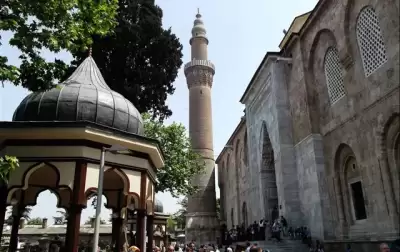
Located in Bursa's Yıldırım district, the Green Complex (Yeşil Külliyesi) is an early Ottoman building complex consisting of a mosque, tomb, madrasah, imaret, and Turkish bath, built by Çelebi Sultan Mehmed between 1419-1421, and admission is free.
The Green Complex (Yeşil Külliyesi) was established by Çelebi Sultan Mehmed, the fifth sultan of the Ottoman Empire, on a hill overlooking the city in Bursa's Yıldırım district. The complex, whose foundation was laid in 1419, was completed shortly before the sultan's death in 1421. The building complex consists of a mosque, tomb, madrasah, imaret, and Turkish bath. A caravanserai, which was part of the complex, has not survived to the present day.
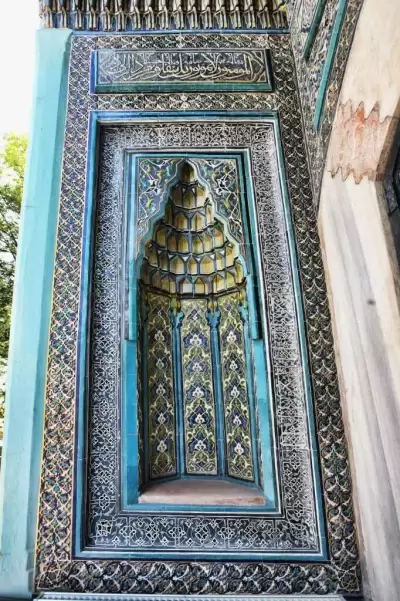
The green tiles that give the complex its name create a strong integrity, especially in the interior of the mosque and on the walls of the tomb. This craftsmanship, representing the pinnacle of 15th-century Ottoman tile art, is attributed to the masters of Bursa of that period. Inside the Green Tomb, in addition to Çelebi Sultan Mehmed, there are also sarcophagi of his sons, daughters, and wet nurse. The complex continues to be one of Bursa's most important visitor points for both faith tourism and architectural and art history.
Guide's Note

What is the Green Complex (Yeşil Külliyesi)?
The Green Complex (Yeşil Külliyesi) is one of the most integrated building complexes from the early Ottoman architectural period. Çelebi Sultan Mehmed commissioned this complex as both a place of worship and a social service center after the Interregnum, during which he re-established Ottoman unity in Anatolia. The complex, consisting of a mosque, tomb, madrasah, imaret, and Turkish bath, carries important clues about the urban planning of the period.
The green tiles that give the complex its name are a product of a tile tradition unique to Bursa. These tiles, used extensively on both the exterior and interior of the buildings, make the complex like an open-air museum of Ottoman tile art.
Structures of the Complex
Green Mosque (Yeşil Camii): Built between 1419-1421, the mosque stands out with its inverted T-plan. The color harmony and craftsmanship of the tile panels in the interior are an original document of 15th-century Ottoman art. The mihrab niche and the crown gate showcase the mastery of the stone and tile artisans of the period.
Green Tomb (Yeşil Türbe): Located directly opposite the mosque, at the highest point of the complex. Inside the octagonal tomb are the sarcophagi of Çelebi Sultan Mehmed and the graves of his family members. The green tile cladding on the exterior of the tomb has become one of the recognized symbols of Bursa's skyline.
Madrasah: The educational unit of the complex, the madrasah, now serves as a museum. With its courtyard structure, it is considered one of the early examples of traditional Ottoman madrasah architecture.
Imaret and Turkish Bath: The imaret, which formed the social service dimension of the complex, was used for distributing food to the poor. The Turkish bath stands out as one of the elements completing the daily life cycle of the complex.
When to Visit?
The most suitable period to visit the Green Complex (Yeşil Külliyesi) is between April-May and September-October. During these periods, the weather is neither too hot nor too cold; the surrounding gardens and Bursa's green texture also look their best. In summer, especially at noon, visitor density can increase. Going in the early morning provides a calmer environment and much more favorable lighting conditions for photography.
The mosque can be crowded during Friday prayers and religious holidays; it would be wise to consider these times when planning your visit.
How to Get There?
The Green Complex (Yeşil Külliyesi) is located on a hill in Bursa's Yıldırım district, approximately 2-3 km from the city center. Those preferring public transport can use the municipal buses going to the Yeşil district via Atatürk Street. If you are coming by Bursaray (light metro), you can get off at Şehreküstü Station and reach it by taxi or on foot.
For those coming by car, there is limited parking around the complex; finding a parking spot can be difficult on weekends and holidays. If you are visiting Bursa's historical center, you can add the Grand Mosque and Covered Bazaar to your itinerary and plan the Green Complex as your second stop of the day.
Photo Spots
The Green Complex (Yeşil Külliyesi) is an extremely fruitful place for photography enthusiasts. The exterior of the Green Tomb offers striking shots, especially in the morning light; the tile cladding of the octagonal structure gains a deep richness of color with natural light. The crown gate and mihrab niche of the mosque constitute a rich source for detailed photography.
Thanks to the complex's hilltop location, it is possible to obtain beautiful panoramic photos from angles overlooking the Bursa plain and city skyline. The colonnades and arcaded passages in the madrasah courtyard are very suitable for architectural composition experiments. At sunset, the tiles of the tomb take on a golden yellow hue.
What to Eat Nearby?
Many local delicacies await you around the Green Complex (Yeşil Külliyesi) and in Bursa's historical center. For Bursa's world-renowned İskender kebab, you can head to established restaurants around Atatürk Street and Heykel Square. Bursa pide and Kemalpaşa dessert are also among the city's unique flavors.
There are small cafes and restaurants in the Yeşil district near the complex; especially at lunchtime, establishments serving simple but satisfying Turkish home-cooked meals are a good option. If you combine your visit with the Covered Bazaar, traditional restaurants inside the bazaar can also be considered.
Suggested Itinerary
For those who want to visit Bursa in a single day, this itinerary provides a practical framework: Start early in the morning with the Grand Mosque (Ulu Camii), then visit the historical Covered Bazaar and Bedesten. Take a break for İskender kebab for lunch. In the afternoon, move to the Yeşil district and visit the Green Mosque, Green Tomb, and Madrasah. You can end the day by enjoying the city view at Tophane Park.
For a two-day program, the route suggested for the second day includes Uludağ, Cumalıkızık village, and the Muradiye Complex. This way, you can explore both the natural and historical layers of Bursa much more comfortably.
Things to Know Before Visiting
The Green Mosque is an active place of worship; appropriate attire is expected during visits. Female visitors are required to cover their heads; headscarves can usually be provided at the mosque entrance. Don't forget to remove your shoes.
Due to the complex's hilltop location, there are stairs and sloping paths around it; therefore, wheelchair or stroller use can be difficult. Paying attention to noise levels during your visit is important for respecting both worshippers and other visitors. You may need to wait inside during prayer times when taking photos.
This content originates from neresigezilir.com.tr and may not be copied without permission.
FAQ
Green Complex (Yeşil Külliyesi) videos load when you open this section to keep the page fast.
Updated: