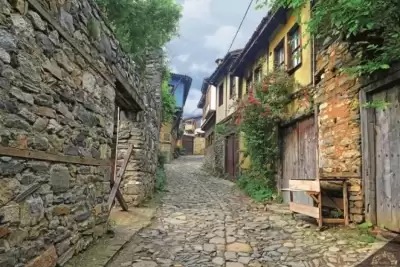
Ahmed Pasha Madrasa is an Ottoman madrasa built in the 15th century by Ahmed Pasha, located on Beşikçiler Street in Bursa's Osmangazi district, and is currently used as a museum housing an Ottoman clothing collection.
Ahmed Pasha Madrasa stands in one of the most interesting corners of Bursa's historical fabric, right next to the Muradiye Complex. The structure was built by Ahmed Pasha, son of Veliyüddin, a renowned poet and statesman of the Fatih Sultan Mehmet era. The aim was not merely to establish an educational institution, but to create an elite scholarly environment where leading scholars of the period would teach. Also known as Geyikli Madrasa among the public, the building presents a robust and original example of Ottoman architecture with its cut stone walls.
The madrasa has undergone four renovations since the 16th century, with the most recent comprehensive restoration in 1999. Today, the structure is open to visitors as a museum housing Ottoman clothes collected by Esat Uluumay over fifty years. The opportunity to closely examine Ottoman clothing culture within a historical educational building elevates the madrasa far beyond an ordinary historical site.
Guide's Note

Visitor comments shared about Ahmed Pasha Madrasa in the last six months are quite limited, making it difficult to provide a comprehensive evaluation. While the majority of existing feedback is positive, it falls short of offering a detailed impression of the venue.
One visitor noted that the venue is affiliated with a foundation, while another expressed satisfaction with a managerial change. However, these comments do not contain concrete information about the physical condition of the venue, visiting conditions, or services offered.
If you are considering visiting this venue, we recommend that you keep in mind that the existing comments may not provide sufficient preliminary information. It would be healthier to obtain information about current opening hours and access conditions from the relevant institution before your visit.
History and Significance of the Madrasa
Ahmed Pasha Madrasa is one of the rare structures carrying the cultural heritage of the Fatih Sultan Mehmet era. Ahmed Pasha, son of Veliyüddin, a renowned poet and statesman of the period, conceived this madrasa not as an ordinary educational institution, but as an elite center of learning where the best scholars of the time would teach. The simple plan scheme, consisting of a single space, clearly reveals that the structure was designed to create a functional and focused educational environment.
It is not precisely known how the structure, popularly known as Geyikli Madrasa, acquired this name. Like many structures in Bursa's historical districts, this madrasa also gained a different identity in popular language over time. The building, which has undergone four renovations since the 16th century, achieved its current appearance with the last restoration in 1999.
When to Visit?
Considering Bursa's mild climate, the most suitable periods to visit the madrasa are April-May and September-October. During these seasons, the plane and Judas trees in the Muradiye district add a special beauty. Bursa can be quite crowded in the summer months; arriving early in the morning allows for a calmer visit and better photographic conditions.
Since the madrasa is located right next to the Muradiye Complex, it is quite logical to visit both structures on the same day. Weekday visits may be preferred due to less tourist density.
How to Get There?
Ahmed Pasha Madrasa is located on Beşikçiler Street in Bursa's Osmangazi district, near the Muradiye Complex. To reach the Muradiye district from Bursa city center, you can use public buses and dolmuşes. It is possible to reach the madrasa with a short walk after getting off at the Muradiye stop.
If you are coming by private car, there are a limited number of parking spaces around the Muradiye Complex. Since traffic can be heavy in Bursa's historical center, public transport or walking is a much more practical option.
Suggested Route: Muradiye Surroundings
If you create an itinerary that includes the historical structures around Ahmed Pasha Madrasa instead of visiting it alone, you will have a much more productive day. Since the Muradiye Complex and its tombs are right next to it, you can start from there as your first stop.
Afterward, you can proceed to the Hisar district to examine structures from the early Ottoman period, and in the afternoon, continue your walk towards the Grand Mosque (Ulu Cami) and the Covered Bazaar. This route allows you to follow Bursa's historical layers in chronological order.
What to Eat Nearby?
The Muradiye district and its surroundings are full of small restaurants and coffee houses offering traditional Bursa delicacies. The unique İskender kebab of Bursa should be an indispensable stop on your visit; the long-established İskender restaurants in the city center are the most reliable addresses for this.
Bursa's famous candied chestnuts and İnegöl meatballs are also among the tastes that must be tried. Taking a short break with Bursa-style desserts and tea in the small patisseries around Muradiye makes you feel the atmosphere of the historical district better.
Photo Spots
The cut stone facade of Ahmed Pasha Madrasa creates strong shadow and texture plays, especially in the morning light. Close-up shots highlighting the entrance and stone craftsmanship of the building offer a good opportunity to document the details of Ottoman architecture.
Wide-angle photos framing the madrasa along with the garden of the Muradiye Complex also yield quite impressive results. The Ottoman clothing collection exhibited in the interior is a rich source for detailed photography; however, it is advisable to confirm on-site whether photography is permitted.
Things to Know Before Visiting
Before visiting the madrasa, it is advisable to confirm opening hours and possible closing days from official sources or on-site. Historical structures can sometimes be temporarily closed for restoration or events.
Since the building is a space converted from a historical educational institution, respectful and quiet behavior is expected inside. It is appropriate to ask officials for information regarding photography in the collection exhibition area. Wheelchair access may be limited, so disabled visitors are advised to inquire in advance.
This content originates from neresigezilir.com.tr and may not be copied without permission.
FAQ
Updated: