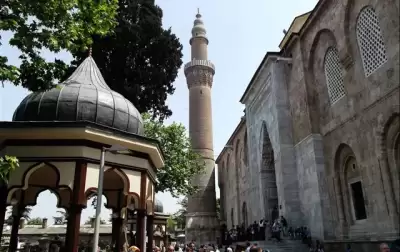
The Hudavendigar Complex is an Ottoman complex located west of Bursa, built by Murad I between 1363-1366; it consists of a mosque, madrasah, imaret, Turkish bath, fountain, and tomb.
When Murad I, the third Ottoman Sultan, ascended to the throne, he set out to shape Bursa not only as a capital but also as a city of knowledge and worship. The Hudavendigar Complex is the most tangible product of this will. The construction of the complex, built on a hill overlooking the west of Bursa between 1363 and 1366, took approximately 19 years to complete. The neighborhood where the complex is located is considered one of Bursa's oldest settlements.
The most striking structure of the complex is its dual-function mosque, designed with the lower floor as a mosque and the upper floor as a madrasah. This two-story arrangement is an extremely rare solution in Ottoman architecture, showcasing the originality of the architectural understanding of the period. In addition to the mosque, the complex also includes an imaret, a Turkish bath, a fountain, and the tomb of Murad I. The Sultan's body was brought here after the Battle of Kosovo (1389), while his internal organs were buried on the battlefield. The complex also played a decisive role in the city's westward expansion.
Guide's Note

Located on a high position in the Çekirge district, the Hudavendigar Complex leaves a deep historical impression on the vast majority of visitors. Dating back to 1365-1366, the structure stands out with its integrity comprising a mosque, madrasah, and tomb. The upper floor of the two-story building houses an 18-room madrasah; in addition to the mosque, the tombs of Murad I and the princes are also part of the complex.
Visitors particularly appreciate the building's commanding view of Bursa and its garden. The aesthetic of the mosque's interior and exterior architecture is a point emphasized by many. The general atmosphere of the complex stands out as a suitable destination for those seeking a calm and peaceful environment.
Some practical information and points to note that may be useful before your visit:
- The upper floor is only open for Friday prayers; if you wish to see the madrasah, it is recommended to plan your visit day accordingly.
- A few visitors recommend coming with someone knowledgeable about the subject or taking a guided tour to fully grasp the historical layers of the structure.
Best Time to Visit
Since Bursa is a city where all four seasons can be experienced, you can visit the complex for most of the year. Spring months, especially April and May, stand out for their mild weather and the peak of surrounding greenery. September-October similarly offers a comfortable visit. In mid-summer, walking outdoors during midday can be tiring; if you prefer early morning hours, you will have a cooler stroll and a calmer environment. As the mosque will be crowded during Friday prayer times, it would be more appropriate for those who want to examine the architecture in detail to choose times outside these hours.
How to Get There?
The complex is located in the Osmangazi district of Bursa, close to the city center. It is quite easy to reach by municipal buses and minibuses; you can check the Bursa Metropolitan Municipality's application or website for routes. If you are coming by private car, there are parking areas around the complex. Most of the lines going towards Uludağ University in Bursa pass through this area.
Architecture and History of the Complex
The most distinctive feature that sets the Hudavendigar Complex apart from other early Ottoman structures is the two-story design of the mosque. The lower floor houses the prayer area, while the upper floor contains madrasah cells. The combination of these two functions within a single structure is considered an original experiment rarely seen in other examples of Ottoman architecture. The building belongs to a period when the Ottoman Empire was still searching for its own unique architectural language, and in this respect, it serves as a primary source for architectural historians.
The tomb of Murad I lies within the complex. The Sultan lost his life in the Battle of Kosovo in 1389; while his internal organs were buried on the battlefield, his body was brought to Bursa and placed in this tomb. The tomb continues to be one of the important pilgrimage sites for the Ottoman dynasty in Bursa.
Photography Spots
The two-story mosque facade of the complex is a subject in itself for those who want to take photographs. In the early morning light, the texture of the stone masonry and the play of shadows create very impressive images. The courtyard in front of the tomb is also quite suitable for calm and framed compositions. The hill where the complex is located is also a good stop for panoramic views overlooking the western side of Bursa; it is possible to capture the city skyline with a wide-angle lens. When taking photos indoors, it is necessary to pay attention to prayer times and not disturb those who are worshipping.
What to Eat Nearby?
The Hudavendigar neighborhood where the complex is located, and its immediate surroundings, are home to Bursa's well-established restaurants and breakfast spots. There are many options within a few minutes' drive from the city center to try Bursa's unique İskender kebab. Completing your morning visits with a rich Bursa-style breakfast is also a worthwhile idea. The city's famous candied chestnuts and chocolate shops are also located close to this area.
Things to Note Before Visiting
Since the complex remains an active place of worship, you are expected to remove your shoes and wear appropriate clothing when entering the mosque. Female visitors may need to cover their heads; it would be advisable to inquire beforehand whether coverings are available at the complex for this purpose. As some structures may be under restoration or closed, confirming the current status with local sources before your visit will make things easier. A quiet and respectful demeanor is expected during tomb visits.
Suggested Historical Route in Bursa
You can create a wonderful day trip by combining the Hudavendigar Complex with other historical structures in Bursa. After visiting the complex in the early morning, you can proceed to Bursa Castle and the Hisar district. In the afternoon, visiting the Muradiye Complex and its surrounding tombs, and then stopping by the Grand Mosque in the evening, offers a logical sequence. Since Bursa's historical fabric is concentrated in close proximity, this route can be completed on foot or with short car rides.
This content originates from neresigezilir.com.tr and may not be copied without permission.
Hudavendigar Complex (Murad I Complex) Videos
Hudavendigar Complex (Murad I Complex) videos load when you open this section to keep the page fast.
Show videos
FAQ

Updated: