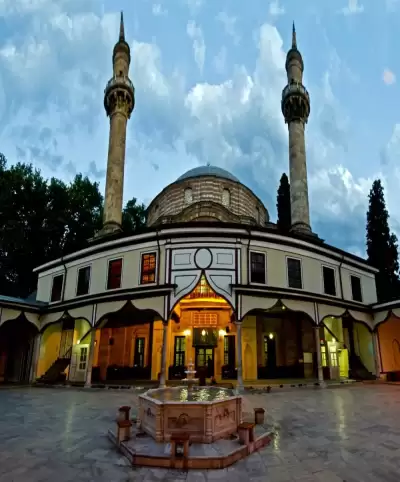
Emir Sultan Mosque is an Ottoman architectural structure built in the early 15th century in the Yıldırım district of Bursa. Known for its widest dome among Bursa mosques, handmade stone craftsmanship, and tile decorations, the mosque is accompanied by its tomb and a historical cemetery. Admission is free.
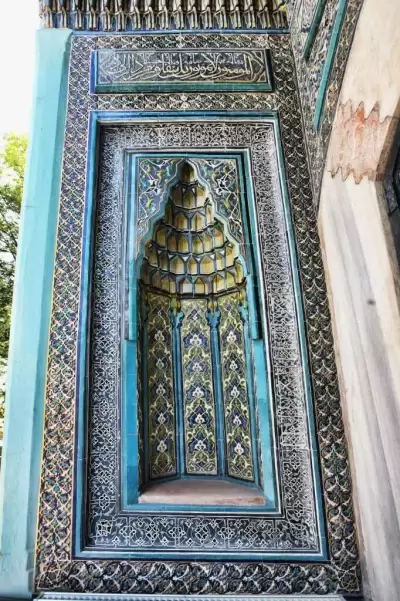
Emir Sultan Mosque was built in the early 15th century by Hundi Hatun, daughter of Yıldırım Bayezid, after the death of her husband Emir Sultan. The structure, measuring 15.20 x 15.20 meters, is built with cut stone and brick; it has two minarets at its northeast and northwest corners. The single dome rests on an octagonal drum, and the mihrab is adorned with 17th-century Iznik tiles. In subsequent renovations, it was rebuilt in marble, and Corinthian-capitaled columns were added to its sides.
The courtyard is accessed by climbing the western stairs and passing through the gate between two columns. A wooden-arched portico supported by sixteen marble pillars surrounds the courtyard; in the center is a fountain, to the south is the mosque, and to the north are the tomb and wooden rooms. After the tomb fell into disrepair, it was rebuilt in 1868 during the princedom of Abdülhamid II. Most visitors derive the main impact not from the architecture, but from the tranquility they feel as soon as they enter the courtyard. Some come to pray, others just sit for a few minutes and leave.
During the Ottoman period, the complex was not only a place of worship but also one of the centers of Sufism and dervish lodge life. When Evliya Çelebi visited here in the 17th century, he mentioned the dervish cells around the mosque. Today, this hill, which gives its name to the Emir Sultan Neighborhood, is still one of the points where the green texture of Bursa can be seen when viewed from the direction of Tophane.
Related discoveries: Historical Places, Bursa historical places, Muradiye Complex.
Guide's Note
About Emir Sultan Mosque
The mosque is named after Emir Sultan, son-in-law of Yıldırım Bayezid. Hundi Hatun had this structure built after her husband's death. Cut stone and brick walls, a single dome on an octagonal drum, and two minarets define the exterior of the building. The 17th-century Iznik tiles in the mihrab were damaged over time and rebuilt with marble during restorations. The Corinthian-capitaled columns on its sides still retain their original detail.
Best Time to Visit
As it is a mosque, it can be visited in all seasons, but entry during prayer times is somewhat restricted. Morning hours and weekdays before noon are quieter for those who want to avoid crowds. In summer, the centuries-old trees in the courtyard provide shade, creating a comfortable waiting area during the midday heat.
How to Get There
From the city center, municipal bus lines 1A, 6A, 6E, 25D, 36, 36A, and 99 go to Emir Sultan Neighborhood. Lines 602, 618, 624/K, and 631 also stop at nearby stops. For those walking from Kent Meydanı, the distance is medium, but there is an ascent. The last part is a slight slope as it is on a hill. If you are going by taxi or your own car, there is parking available around the mosque.
How Long Does the Visit Take
Visiting the mosque and the tomb in the courtyard usually takes around half an hour. This time may extend for those who want to take photos or sit and relax in the courtyard. It can be combined with the nearby Green Tomb and Yıldırım Madrasa for a half-day tour of the Yıldırım district.
Other Stops Nearby
Within close proximity to Emir Sultan Mosque are the Green Tomb, Yıldırım Madrasa, and the Tombs of Osman and Orhan Gazi. It is also a reasonable distance from the Bursa Teleferik station, so those who want to go up Uludağ after visiting the mosque can split their day. When viewed from the direction of Tophane Castle, the hill where the mosque is located is one of the points showing the green texture of the city.
Things to Know Before Visiting
As it is a mosque, appropriate modest clothing is important; headscarves can be provided at the entrance for female visitors. Shoes must be removed, and there is a shoe rack in the courtyard for this purpose. During prayer times, entry to the interior for tourist visitors may be restricted, so visiting the courtyard and tomb is more suitable during these hours.
Good Spots for Photography
The sixteen-pillared portico and wooden arches in the courtyard provide good shots, especially in the afternoon light. The area around the ablution fountain and the facade of the tomb are also preferred angles. The centuries-old trees around the mosque create a green background, highlighting the architectural details.
FAQ
Emir Sultan Mosque videos load when you open this section to keep the page fast.
Updated: