


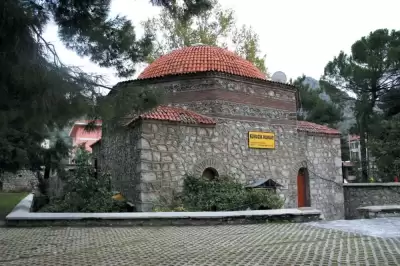
Amasya Bayezid II Complex is an Ottoman complex located on the banks of the Yeşilırmak River, built between 1485-1486 by 艦ehzade Ahmet on behalf of his father Sultan Bayezid II. The complex, consisting of a mosque, madrasah, imaret, and fountain, is one of the few sultan mosques in Anatolia; the mosque and its courtyard are free, while a separate fee is charged for the Amasya Miniature Museum.
The Bayezid II Complex was built between 1485-1486 by 艦ehzade Ahmed, the Sanjak Bey of Amasya, under the instructions of Bayezid II. It is one of the distinguished examples of the mosque architecture with side spaces or zawiya-style. There are two square spaces separated by a large arch in the middle, with three-domed side spaces on the east and west. The interior of the two large domes covering the central space and the areas above the window arches are adorned with rich penmanship. The wooden window shutters are beautiful examples of 15th-century kündekari technique. The areas above the windows in the last congregation section are covered with blue and white tile panels.
When the complex was first built, it consisted of five separate units including an imaret, kitchen, pantry, bakery, and stable; today, the mosque, madrasah, and imaret sections have survived. The tomb of 艦ehzade Osman, son of 艦ehzade Ahmed, who died at a young age, was added to the structure later, and in the 19th century, a muvakkithane (timekeeping house) and a fountain were built. The plane trees planted on both sides of the fountain in the courtyard are over 500 years old; they also serve as lightning rods. Visitors particularly note the time spent under the shade of these trees in the courtyard.
Today, the complex is not just a place of worship. It houses one of 18 manuscript libraries, the Miniature Amasya Museum reflecting Amasya of 1914, and the world's largest Hilye-i 艦erif. In reviews, this Hilye-i 艦erif and the section exhibiting examples of calligraphy are frequently recommended. As it is located on the 艦ehzadeler Walking Path along the Yeşilırmak River, it naturally becomes part of a walking route.
Related discoveries: Historical Places, Amasya historical places, Historical Ferhat Water Canal.
Guide's Note

By Whose Order Was the Complex Built?
The story of the structure is nourished by Bayezid II's attachment to Amasya after his ascension to the throne. As an expression of his gratitude to the city, the Sultan entrusted his son, 艦ehzade Ahmed, the Governor of Amasya, with the task of building this complex. Construction lasted between 1481-1486. In the waqfiyya dated 1496, the complex units are listed as a mosque, madrasah, imaret, school, and a bridge; the bridge is over the Kızılırmak River in Osmancık district of 脟orum. Thus, the influence of the complex extended beyond the borders of Amasya.
Architectural Details of the Mosque
The mosque consists of two square spaces separated by a large arch in the middle; there are three-domed sections on each side. Sixteen windows are opened in the octagonal drums of the two large domes covering the central space, and the interior of the domes and the areas above the window arches are adorned with penmanship. The three-line marble inscription above the stone gate is the work of Calligrapher Ali bin Mezid. Of the two minarets, the body of the eastern one is vertically fluted, while the body of the western one has zigzag stone decoration. This distinction is easy to notice when taking photographs.
Best Times to Visit
Going towards noon is beneficial: the blue and white tile panels in the last congregation area appear most vibrant with the light at those hours. The shade of the plane trees in the courtyard is preferred for sitting during the midday heat. Since the mosque may be closed for visits during prayer times, it is sensible to spend those hours outside and explore the courtyard.
Transportation
The complex is in the city center, in Hacı İlyas Neighborhood. As it is located on the 艦ehzadeler Walking Path along the Yeşilırmak River, it can be reached on foot within 10-15 minutes from hotels in the center and the Yalıboyu Houses. For those arriving by car, there is limited parking space around the mosque.
How Much Time to Allocate
Visiting the mosque and its courtyard takes 30-40 minutes. If you also include the Hilye-i 艦erif and calligraphy exhibition in the garden, the library, and the Miniature Amasya Museum, the duration extends to 1-1.5 hours. Other central attractions of Amasya, the Yalıboyu Houses and the King Rock Tombs, are within walking distance, so they can easily be fitted into the same day.
Other Stops in the Vicinity
From the complex, it is possible to walk along the Yeşilırmak riverbank to reach the Yalıboyu Houses and the King Rock Tombs on the opposite slope. These three can be combined into a single walking route. The evening light makes the view over the river more suitable for photography.
Things to Note Before Visiting
Since the mosque is an active place of worship, appropriate clothing for modesty and removal of shoes are required. There are seating areas around the plane trees and the fountain in the courtyard. The museum and library sections may have separate operating hours; it is necessary to check in advance if this section is open when planning your visit.
FAQ
Updated:


