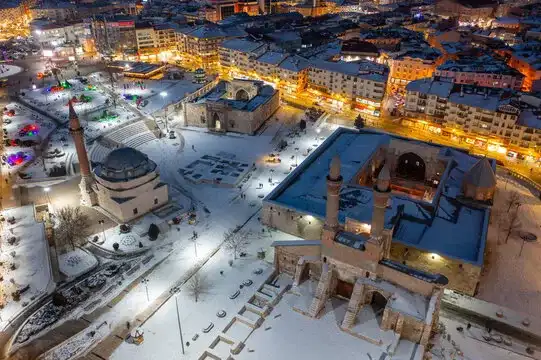
Sivas Places to Visit
Sivas, located in Turkey's Central Anatolia Region, is a deeply rooted city stretching back into the depths of history. The city center, adorned with madrasahs, mosques, and caravanserais from the Seljuk period, hosts on…
When to Visit Sivas?
Sivas has a continental climate typical of Central Anatolia; summers are hot and dry, while winters are quite cold and snowy. Therefore, the timing of your visit varies depending on what you want to see.
Spring (April–June) is the most ideal period to visit the city. The weather is mild, nature is lush green, and tourist spots are not crowded. Sitting in the garden of the Double Minaret Madrasah offers a unique pleasure during this season.
Autumn (September–October) is also a good alternative. The heat has subsided, and nature is adorned in yellow-orange tones. The area around Gökpınar Lake offers a visual feast during this season.
While visiting the city center is possible in winter months, transportation can sometimes be difficult. However, visiting Kangal Fish Spa in winter is a distinct experience; relaxing in warm thermal waters under the snow leaves an unforgettable feeling.
During summer months, as the weather is hot and sunny, early morning hours should be preferred for visiting historical structures.
How to Get to Sivas?
There are multiple options to reach Sivas, and the city has very good connections from various points in Turkey.
By Plane: Sivas Nuri Demirağ Airport receives regular flights from several cities, especially Istanbul and Ankara. The airport is located close to the city center and can be easily reached by taxi or shuttle services.
By Bus: Direct bus services to Sivas are available from many major cities in Turkey. Öz Sivas, Yeni Sivas Turizm, and other companies offer regular schedules. The intercity bus terminal is located in the city center.
By Train: Sivas is an important railway junction in Turkey's railway network. Train connections are available from Ankara and Istanbul; especially with the expansion of high-speed train lines, train travel is becoming an increasingly attractive option. The train station is located close to the city center.
By Car: Reaching Sivas by road is also quite practical. It is approximately a 4.5–5 hour drive from Ankara.
Getting Around Sivas
Sivas city center has a compact structure that can be explored on foot. Most of the historical buildings are located close to each other, so if you prefer central accommodation, you can reach many points on foot.
Municipal buses connect different districts of the city. Kent Kart is used for these lines operating within the Sivas Municipality's public transportation network. There is a difference between full fare and student fare; the card can be obtained at points near bus stops.
Taxi services are also widespread throughout the city and offer a practical solution for short-distance travel.
For reaching points outside the city such as Kangal Fish Spa or Divriği, it is recommended to use minibuses or private vehicles. Regular bus services to Divriği are available.
Places to Visit in Sivas
Double Minaret Madrasah: This structure, which has become a symbol of Sivas, is one of the most magnificent examples of 13th-century Seljuk architecture. Its two tall minarets and rich stone carvings deeply impress visitors. It is located right in the heart of the city.
Şifaiye Madrasah (Darüşşifa): Considered the first medical school in Anatolia, this building was constructed in 1217. It is known to have practiced music therapy of its time; in this respect, it holds a unique place in world medical history.
Buruciye Madrasah: Another important Seljuk-era structure, the Buruciye Madrasah, now serves as a museum. The craftsmanship on its crown gate is remarkable.
Sivas Atatürk and Congress Museum: The historical building where the 1919 Sivas Congress was held is an indispensable stop for those who want to experience the history of the War of Independence firsthand. Documents related to the congress and artifacts from that period are exhibited in the museum.
Sivas Archaeology Museum: Housing rich archaeological finds from the prehistoric period to the Ottoman era in the region, the museum is a valuable resource for history enthusiasts.
Divriği Great Mosque and Hospital: Located in the Divriği district of Sivas province, this work has been on the UNESCO World Heritage List since 1985. The extraordinary stone craftsmanship on its crown gates holds a unique place in world architectural history. It is approximately 2.5–3 hours away from Sivas city center.
Kangal Fish Spa: This spa, world-renowned for its small fish (Garra rufa) living in thermal waters believed to be beneficial for skin diseases, especially psoriasis, is approximately 95 km away from Sivas city center.
Gökpınar Lake: This crystal-clear lake, located in the Gürün district, is a wonderful destination for nature walks and photography enthusiasts.
Where to Stay in Sivas?
Accommodation options in Sivas are predominantly concentrated in the city center. Choosing a central hotel ensures you are within walking distance of historical sites and makes exploring the city easier.
The city mainly features mid-range hotels and boutique guesthouses. Alongside major chain hotels, local establishments also offer comfortable accommodation. Hotels around Cumhuriyet Square are advantageous both in terms of location and ease of access.
If you plan to visit Kangal Fish Spa, accommodation is also available at the spa facilities. For therapeutic visits, staying in the spa area for a few days might be more effective.
During peak tourist seasons, especially in summer months and national holidays, it is recommended to make reservations in advance.
What to Eat in Sivas?
Sivas cuisine reflects the simple yet satisfying flavors of Central Anatolia. The city's unique dishes and desserts leave lasting impressions on visitors' palates.
Sivas Köftesi (Meatballs): One of the city's most famous delicacies, these meatballs are grilled and usually served with lavash bread. There is a long-standing rivalry among the city's meatball restaurants; it is worthwhile to try a few different places.
Madımak Çorbası (Knotgrass Soup): Made from madımak, a plant unique to the region, this soup is an authentic flavor you must try when you come to Sivas.
Höşmerim: This dessert, made from cheese and semolina, is one of Sivas's iconic sweets. It is a unique flavor that combines both sweet and savory notes.
Sivas Ekmeği (Bread): Village bread baked in local ovens takes its place on every table in the city. Eating fresh oven-baked bread for breakfast is an experience in itself.
You can find homemade dishes in local restaurants in the city center and in places near market areas. In addition to tourist restaurants, exploring small artisan eateries preferred by locals will help you get to know Sivas cuisine better.
Cultural Fabric of Sivas
Sivas is one of the cities in Anatolia with the deepest cultural heritage. Hittite, Roman, Byzantine, Seljuk, and Ottoman civilizations have left their mark on these lands; each period has added a distinct layer to the city's fabric.
The Sivas Congress has permanently cemented the city's place in modern Turkish history. The congress, held between September 4–11, 1919, played a critical role in organizing Anatolia against occupation. Due to this historical importance, the city hosts various commemoration events every September.
Sivas is also one of the important centers of Alevi culture. The connection of great Alevi poets like Pir Sultan Abdal with these lands has deeply shaped the city's cultural identity. The local folk music and saz tradition are living parts of this cultural heritage.
The Pir Sultan Abdal Culture and Art Festival, held annually in June, attracts participants from all over Turkey to Sivas.
This content originates from neresigezilir.com.tr and may not be copied without permission.
Places to Visit

Kale Mosque
An Ottoman mosque built in 1580 by Vizier Mahmud Pasha in Sivas Historical City Square. With…

Sivas Archaeology Museum
Housed in the former Industrial School building, the museum boasts a collection ranging from…

Hafik Lake
A karstic lake in the Kızılırmak basin, 40 km from Sivas. A natural protected area known for…

Sıcak Çermik Thermal Spring
A thermal spring located 30 km from Sivas, known for its 45-50°C thermal water. It's a famil…

Güdük Minare (Sheikh Hasan Tomb)
A tomb built in 1347 by Alaaddin Eratna, founder of the Eretnid State, for his son Sheikh Ha…

Gökpınar Lake
A natural lake in Gürün district of Sivas, at an altitude of 1500 meters, fed by turquoise s…

Divriği Great Mosque and Hospital
A UNESCO World Heritage site built in 1228-29 by Mengujekid Ahmed Shah and his wife Turan Me…

Gök Medrese Foundation Museum
A Seljuk madrasa built in 1271 by Sahip Ata Fahrettin Ali in the center of Sivas. Known for …

Twin Minaret Madrasah
A Seljuk madrasah from 1271, a symbol of Sivas city square. Only its twin-minaret crown gate…

Sivas Grand Mosque
Dating back to the Anatolian Seljuk period, built in 1197 and known for its leaning minaret,…

Sızır Waterfall
A natural protected area in the Gemerek district of Sivas, where the Göksu Stream cascades f…

Buruciye Madrasah
A Seljuk madrasah built in 1271 by Muzaffer Burucerdi. Located in Sivas Cumhuriyet Square, t…

Kurşunlu Bathhouse
Built by Behram Pasha in 1576, this double bathhouse has served the same function for 5 cent…

Suğul Canyon
A natural area in Gürün district of Sivas, shaped by a clear stream flowing through rocks an…

Sivas Atatürk and Congress Museum
The 1892 building where the Sivas Congress convened is now a museum depicting the headquarte…

Sivas Castle
The remains of a castle rising on a mound named Topraktepe in the city center of Sivas. The …

Aşık Veysel Museum
The house where Aşık Veysel lived in Sivrialan village, Şarkışla. A museum since 1982; his s…

Şifaiye Madrasah
A Seljuk structure built as a hospital in 1217 by Izz ad-Din Kaykaus I. Located in Sivas cit…

Eğri Köprü (Crooked Bridge)
A 18-arched, 179-meter long stone bridge from the Seljuk period over the Kızılırmak River. A…

Soğuk Çermik Thermal Spring
Soğuk Çermik Thermal Spring, located 17-18 km from Sivas on the Sivas-Erzincan highway, is k…

Sarissa Ancient City
One of the most important Hittite settlements outside the capital Boğazköy, located in the A…

Divriği Castle and Mosque
Located in Divriği district of Sivas, this castle from the Mengujekids period stands on a ro…

Susamışlar Mansion
A 19th-century wooden mansion in Sivas's İnönü Neighborhood. It was used as a Mevlevi lodge …

Doğanşar Dipsiz Lake and Waterfall
In Doğanşar district of Sivas, the volcanic Dipsiz Lake, 10 meters deep, and the 50-meter wa…