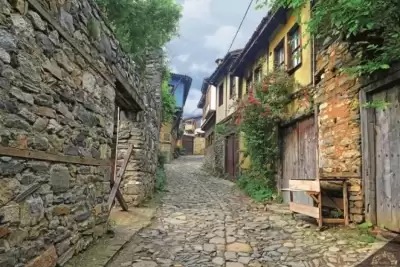
Located within the Murad I Hüdavendigar Complex in Bursa's Çekirge district, this historic ablution fountain and fountain is a unique example of Ottoman water architecture, with hot water flowing from one spout and cold water from the other.
Located in Bursa's Çekirge district, this fountain and ablution fountain, part of the Murad I Hüdavendigar Complex, is one of the modest but significant structures that have survived from the Ottoman period to the present day. Positioned between the Hüdavendigar Mosque and the tomb, the ablution fountain has an interesting feature with its two fountains standing side by side: one flows hot water, the other cold water. Natural thermal springs passing beneath the structure explain this situation; Bursa's deep-rooted thermal bath tradition is also evident here.
The Hüdavendigar Complex dates back to the reign of Murad I, the fourth Ottoman Sultan; it is a large complex of structures consisting of a mosque, madrasah, hammam, and tomb. The fountain and ablution fountain are also an integral part of this complex. The entire complex is among the areas evaluated under the UNESCO World Heritage List of Ottoman monuments in Bursa. The main attraction for visitors is being able to personally experience the unique quality of this water, in addition to the historical structures.
Related discoveries: Places to visit in Bursa, Historical Places, Historical places in Bursa, Bursa Grand Mosque.
Guide's Note

The Hüdavendigar Fountain and Ablution Fountain is located in a high position in Bursa's Çekirge district, and the vast majority of visitors describe this place as having a deep historical atmosphere. Dating back to 1365-1366, the structure stands out with its two-story architecture; there is an 18-room madrasah on the upper floor. This complex, consisting of a mosque, tomb, and madrasah, also houses the tomb of Murad I, the third Ottoman Sultan.
Visitors particularly appreciate the location of the venue, which overlooks Bursa, and its garden. The aesthetic appeal of both the interior and exterior architecture of the mosque, and the peaceful and calm environment it offers, are frequently highlighted in comments. For those interested in history, the integrity offered by the mosque, tomb, and madrasah together is also considered valuable.
- Guided visit recommendation: At least one visitor states that coming with someone knowledgeable about the subject would be more productive to fully grasp the place.
- Upper floor access: It is reported that the upper floor of the building is only open to visitors during Friday prayers; if you come on a different day, you may not be able to see this floor.
About the Structure
The Hüdavendigar Fountain and Ablution Fountain is located within the Murad I Hüdavendigar Complex in Bursa's Çekirge district, between the mosque and the tomb. The complex was built by Murad I (Hüdavendigar), the fourth Ottoman Sultan, in the 14th century. The ablution fountain bears the characteristic features of Ottoman water architecture of its period; it stands out with its simple stone masonry and functional design.
Its most interesting feature is that one of the two fountains belonging to the ablution fountain flows hot water, and the other flows cold water. This situation, which shows how rich Bursa is in terms of thermal springs, distinguishes the structure from an ordinary historical fountain. Visitors can experience this water firsthand.
When to Visit?
The structure can be visited all year round; however, Bursa's spring and autumn months are the most enjoyable periods, both in terms of weather conditions and the atmosphere of the complex integrated with greenery. In summer, the Çekirge region becomes lively with thermal tourists; visiting in the morning offers a much calmer experience. The area around the mosque gets crowded during Friday prayer times; it is good to keep this in mind.
How to Get There?
Regular municipal buses run from Bursa city center to Çekirge. You can easily reach it with lines that stop near the Hüdavendigar Mosque. For those arriving by car, it is possible to find parking around the complex. Since it is also close to Bursa's cable car station, it can be combined with a visit to Uludağ on the same day.
Çekirge, which is approximately 3–4 km from Bursa city center, is a point that can be reached quickly by taxi. It is recommended that public transport users check Bursa Metropolitan Municipality's route information in advance.
Suggested Itinerary
Visiting the Hüdavendigar Fountain and Ablution Fountain along with the other structures of the complex is the most logical approach. After visiting the Hüdavendigar Mosque and tomb, visit the ablution fountain; then you can take a short walk on the street where Çekirge's thermal hotels are concentrated.
For the rest of the day, you can combine it with other historical sites in Bursa such as the Green Mosque, Grand Mosque, and Covered Bazaar to create a comprehensive Bursa tour. It is quite easy to transfer from Çekirge to the city center by dolmuş (shared taxi) or bus.
Photo Spots
The stone masonry of the ablution fountain and the general appearance of the fountains offer beautiful shots, especially in the morning light. It is possible to capture the facade of the Hüdavendigar Mosque and the ablution fountain in the same frame. The courtyard of the complex is very suitable for wide-angle shots showing the historical structures together.
In autumn, the atmosphere becomes even more beautiful with the changing colors of the trees around the complex. When taking photos, it is important to avoid entering the mosque during prayer times.
What to Eat Nearby?
The Çekirge district hosts various restaurants offering prominent flavors of Bursa cuisine. İskender kebap is a symbol of Bursa and can be found in most of the well-established restaurants in the region. İnegöl meatballs and candied chestnuts are also must-try delicacies.
Cafes on Çekirge Street, restaurants in thermal hotels, and small local eateries in the vicinity offer practical options for lunch. Bursa's famous peaches and tarhana can also be easily found in the region.
Things to Consider
The ablution fountain and fountain are part of an active religious complex. It is important to be quiet and respectful during your visit. Do not enter the mosque during prayer times; women are expected to cover their heads.
The ground is paved with stone and can be slippery in wet weather; it is advisable to wear appropriate footwear. There are no specific accessibility arrangements for disabled visitors around the structure. Although the water from the fountains is potable, care should be taken when touching the hot water fountain.
FAQ
Hüdavendigar Fountain and Ablution Fountain videos load when you open this section to keep the page fast.

Updated: