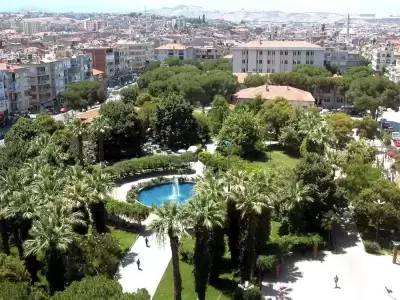
The Muradiye Mosque and Complex is an Ottoman-era building complex located in Manisa's Saruhan Neighborhood at the foothills of Mount Spil, built by Murad III between 1583 and 1592; it consists of a mosque, madrasah, imaret, and shops, with the madrasah building currently serving as the Manisa Museum.
When you visit Manisa, the Muradiye Mosque and Complex, located in Saruhan Neighborhood at the foothills of Mount Spil, was built by the Ottoman Sultan Murad III between 1583 and 1592. The architecture of the complex is attributed to Mimar Sinan, which adds significant historical and architectural weight to the structure. The mosque is the second structure built by Sultan Murad in Manisa and is considered among the city's most important Ottoman-era works.
The complex is not merely a place of worship. This group of structures, comprising a mosque, madrasah, imaret, and shops, concretely reflects the social and urban organization principles of the Ottoman period. The madrasah building is currently used as the Manisa Museum, where artifacts unearthed during archaeological excavations in the region are exhibited. With a single visit, you have the chance to see both Ottoman architecture and the region's archaeological heritage together.
Guide's Note

The Muradiye Mosque and Complex attracts visitors as an important group of structures reflecting the classical period of Ottoman architecture in Manisa. Planned by Mimar Sinan in the 16th century in the name of Murad III, the complex consists of a mosque, madrasah, imaret, fountains, and shops. The construction of the building was started by Mimar Mahmut Ağa and completed by Mimar Mehmet Ağa after his death. Having undergone various repairs and restoration works in subsequent centuries, the complex continues to stand today.
Visitors particularly appreciate the tile decorations, pen-work embellishments, and architectural details in the mosque's interior. The mihrab wall, where Iznik tiles are used, and the general atmosphere are among the main elements found interesting by those with an interest in history and architecture. Comments mentioning the peaceful atmosphere of the place also stand out; visitors evaluate it not only as a place of worship but also as a historical experience point.
- Cleanliness: While one visitor found the toilet cleanliness positive, another comment points out that more attention should be paid to the general cleanliness of historical areas. Impressions on this matter vary from person to person.
- Architectural information inconsistency: Some comments contain conflicting information regarding the architect of the structure; although it is generally accepted that the complex belongs to Mimar Sinan, different names are mentioned in some comments. It may be useful to obtain information from reliable sources before visiting.
Best Time to Visit
The most suitable periods to visit Manisa are April-May and September-October. The weather is stable during these seasons, allowing you to comfortably explore the complex and its surroundings. Manisa can be quite hot in the summer months. If you plan to visit in July-August, choosing the early morning hours would be much wiser. The mosque is more crowded during prayer times; those who wish to examine the interior peacefully can choose the intervals between prayers.
How to Get There
The most practical way to reach Manisa is via Izmir. Train and bus services operate regularly from Izmir to Manisa; the journey takes approximately 45 minutes. After arriving in Manisa city center, you can reach the Muradiye Mosque and Complex on foot or by city dolmuşes and minibuses. Since the complex is located in Saruhan Neighborhood at the foothills of Mount Spil, it can be easily seen from different points of the city. If you are coming by car, simply follow the direction to Saruhan Neighborhood; finding parking nearby is usually not a problem.
How Much Time to Allocate
For those who only want to visit the mosque and the outer areas of the complex, 30-45 minutes will be sufficient. If you also plan to visit the Manisa Museum in the madrasah building, it would be more appropriate to extend your total time to 1.5-2 hours. The museum exhibits archaeological finds from the region; the collection has rich content documenting Manisa's history from ancient times to the Ottoman period.
Suggested Itinerary
For those who want to efficiently visit historical sites in Manisa, the following itinerary is recommended: Start early in the morning at the Muradiye Mosque and Complex, then visit the Manisa Museum in the madrasah. In the afternoon, you can explore other Ottoman-era structures in the city, especially the Ulu Mosque and its surroundings. Manisa, thanks to its proximity to Izmir, is very suitable for a day trip; it is perfectly possible to leave early in the morning and return in the evening.
Photo Spots
Among the most striking photo angles of the complex, the courtyard entrance and the main facade of the mosque stand out. The presence of Mount Spil in the background provides a natural frame for the structure. In the morning hours, the light makes the texture of the stone masonry and the silhouette of the minaret much more distinct. The madrasah courtyard, with its colonnaded porticoes and greenery, also holds special value for photography. A wide-angle lens will be useful for those who want to capture the entire complex in a single shot.
What to Eat, Where to Eat
Manisa is a city known nationwide for its mesir paste. This traditional product, prepared from various spices and herbs, has become a symbol of the city over time. During the annual Mesir Paste Festival, the paste scattered to the public from the minaret of the Ulu Mosque is one of Manisa's most unique cultural traditions. In restaurants around the complex, you can try the simple and delicious dishes of Aegean cuisine. Olive oil vegetable dishes, fresh fish, and Manisa kebab are among the prominent flavors.
Things to Know Before Visiting
Since the mosque is an active place of worship, you are expected to wear appropriate clothing during your visit; women need a headscarf and a top that covers their shoulders. You will need to remove your shoes at the entrance. I recommend checking the current operating hours and entrance fee for the museum section before your visit; it may be closed on public holidays. Do not forget to show respect to people praying when taking photos.
This content originates from neresigezilir.com.tr and may not be copied without permission.
Muradiye Mosque and Complex Videos
Muradiye Mosque and Complex videos load when you open this section to keep the page fast.
Show videos
FAQ

Updated: