Ulucak Höyük is a Neolithic settlement located in the Kemalpaşa district of İzmir, with a history spanning over 8,000 years; excavations since 1995 have revealed important findings about Aegean prehistory.
Ulucak Höyük is situated on the 15th kilometer of the Bornova-Turgutlu-Ankara highway, approximately 7 km west-northwest of Kemalpaşa town center. Rising near the Nif Stream, east of the Belkahve pass between the İzmir and Kemalpaşa plains, this mound is one of the foremost archaeological sites containing concrete evidence of the first settled life and agricultural culture in Anatolia. Excavations began in 1995; since then, findings have revealed that the mound has a long settlement history extending from the Neolithic Age to the Bronze Age.
During excavations at the site, extremely rare finds such as three 7,700-year-old human figures have been unearthed. These figures and other archaeological remains clearly demonstrate the significance of the mound not only regionally but also for the prehistory of the Aegean and Eastern Mediterranean. If you are interested in archaeology or prehistoric periods, Ulucak Höyük is a must-visit stop around İzmir.
Guide's Note
What is Ulucak Höyük?
Ulucak Höyük is an archaeological mound composed of settlement layers built one on top of another over thousands of years. The discovery of a continuous settlement trace from the Neolithic Age to the Bronze Age at such a close proximity to İzmir places the mound in a special position in the scientific world. Considered one of the first village settlements in Anatolia, the site provides critical data for understanding how agriculture and animal husbandry spread to the Aegean coasts.
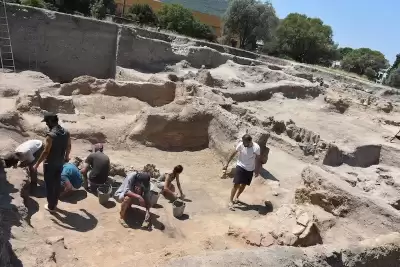
Systematic excavations, which began in 1995, continue to unearth new findings every season. Ceramics, bone tools, architectural remains, and human figures found during the excavations stand out as important evidence documenting the ways of life from different periods of the mound.
Excavation History and Important Finds
Systematic archaeological excavations at the mound began in 1995. The work carried out since then has proven that the area was inhabited from the Neolithic Age through the Chalcolithic and Early Bronze Ages. Among the most striking finds at the mound are three 7,700-year-old human figures; such figurines are extremely rare in the Aegean Neolithic.
Traces of wooden and mud-brick architecture, hearths, storage pits, and various daily use objects have also been unearthed in the building layers. All this data clearly reveals that Ulucak was not merely a seasonal camp but a permanent village settlement.
When to Visit?
The most suitable periods to visit Ulucak Höyük are the spring (April-May) and autumn (September-October) months. During these periods, the weather temperature is favorable for a comfortable outdoor trip; the surrounding lands also offer a beautiful view with green or golden yellow tones.
In July-August, the temperature of the İzmir plain can rise considerably. If you plan to visit in the summer, prefer the early morning hours, and do not forget to take plenty of water and sunscreen with you. In winter, the area is usually deserted and excavation work stops; visiting conditions may be more limited during this period.
How to Get to Ulucak Höyük?
By private car: Follow the highway from İzmir city center via Bornova towards Ankara. You will see the Ulucak Mahallesi sign at approximately the 15th kilometer of the road. The mound is easily visible from the road.
By public transport: There are regular bus services from İzmir to Kemalpaşa. After getting off in Kemalpaşa town center, you can reach the mound by taxi or local minibuses going towards Ulucak. It would be advisable to confirm current bus schedules with local transport companies before your visit.
How Much Time Should Be Allocated?
Ulucak Höyük is an intensive archaeological excavation site, so the area visible to visitors is relatively limited. 1-2 hours will be sufficient to explore the mound and get acquainted with the surroundings. If you have a deep interest in archaeology or find an opportunity for a guided tour, this time may extend.
You can combine the mound with other historical and natural beauties in the Kemalpaşa district to create a half-day or full-day itinerary. Kemalpaşa is also a district worth visiting with its cherry orchards and historical texture.
Suggested Itinerary: Kemalpaşa Day Trip
You can plan a wonderful day trip by combining Ulucak Höyük with other attractions in Kemalpaşa. Go to the mound early in the morning to explore the area in its tranquility. Afterwards, head to Kemalpaşa town center to visit its historical bazaar and mosques.
Kemalpaşa is one of Turkey's most renowned cherry production centers; if it's in season (May-June), don't forget to buy fresh cherries. For lunch, you can try local dishes at the town's restaurants. On your way back, you can easily reach İzmir via Bornova.
Photo Spots
While Ulucak Höyük does not inherently offer a dramatic landscape, it is possible to capture impressive shots when viewed from the right angle. Wide-angle photos looking out from the top of the mound over the Kemalpaşa Plain and surrounding villages yield excellent results.
During periods when the excavation site is open, unearthed architectural layers and cross-sections provide powerful photographic subjects documenting prehistoric life. The soft light in the early morning best highlights the earth-toned mound. At sunset, the silhouette of the mound also offers an interesting photo opportunity.
Things to Consider Before Visiting
Ulucak Höyük is an active archaeological excavation site. Be aware that access to the area may be restricted or certain sections may be closed during the excavation season (usually summer months). It is best to call the İzmir Provincial Directorate of Culture and Tourism or the Kemalpaşa District Governorship before your visit to get up-to-date information on the current situation.
Since the area is in open terrain, it is recommended to wear comfortable walking shoes. Shade is extremely limited around the mound; don't forget to bring a sun hat and water. The basic rule in archaeological sites is not to damage the ground and structural remains, and not to touch any object that might be a find.
This content originates from neresigezilir.com.tr and may not be copied without permission.
Ulucak Höyük Videos
Ulucak Höyük videos load when you open this section to keep the page fast.
Show videos
FAQ

Updated: