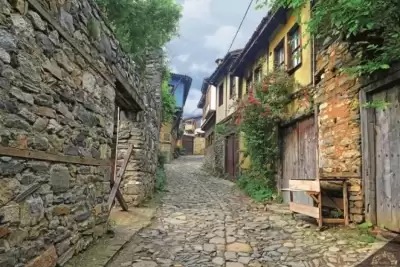
Abdal Mehmed Mosque, located in Bursa's Osmangazi district, is a simple example of early Ottoman architecture built in 1450 by Başçı İbrahim during Sultan Murad II's reign; with its tomb and fountain, it holds value for faith tourism.
Abdal Mehmed Mosque stands near the intersection of Abdal Street, Tahal Street, and Gül Street in the Osmangazi district of Bursa. It was built in the Hijri year 854, corresponding to 1450 AD, by Başçı İbrahim in the name of Abdal Mehmed, one of the renowned Sufis of Sultan Murad II's era. The structure is part of a modest but significant complex that bears important traces of the period's world of faith and mysticism.
Reflecting the typical features of early Ottoman architecture, the mosque was built in an east-west direction and has a transverse rectangular prayer hall. The structure, surrounded by stone walls, has its main entrance on the north facade, and there is also a portico (son cemaat yeri) section. The mosque, along with its tomb and fountain, has survived to the present day, forming a small but complete religious building complex. Although it remains in the shadow of Bursa's more magnificent Ottoman structures, this simplicity adds a distinct originality to the building.
Related discoveries: Places to visit in Bursa, Historical Places, Bursa historical places, Bursa Grand Mosque.
Guide's Note

Abdal Mehmed Mosque, located in Osmangazi, Bursa, is one of the early Ottoman structures built by Başçı İbrahim in the name of Abdal Mehmed, one of the renowned Sufis of Sultan Murad II's era. The rectangular-plan structure is covered by two oval domes side by side, and the portico (son cemaat yeri) is completed with three small domes. It underwent extensive renovation in 1955.
Visitors generally describe the mosque as a simple, small, and peaceful place of worship. Immediately in front of the structure, according to its inscription, is the Abdal Mehmed Tomb and a historic fountain, built in 1450 by Sultan Murad II. This fountain is notable as the only preserved example with an inscription among more than forty fountains that carried Müftü Water from the foothills of Uludağ to Bursa. Visitors also mention that the mosque is located opposite the famous historic Taşfırın (Stone Oven).
The only practical drawback highlighted in comments can be summarized as follows:
- Distance to ablution facilities: It takes approximately five minutes to walk to the ablution facility, which is not part of the mosque.
About Abdal Mehmed Mosque
Abdal Mehmed Mosque is one of the rare structures in Bursa that carries the simple architecture of the Early Ottoman period to the present day. It was built in 1450 by Başçı İbrahim in the name of Abdal Mehmed, one of the important Sufis of Sultan Murad II's era. This small complex, consisting of a mosque, tomb, and fountain, concretely reveals the traces of the Sufi tradition in Bursa.
The structure is not as well-known as Bursa's monumental works like the Grand Mosque or the Green Mosque; however, it is a valuable reference point for those who want to understand the early period of Ottoman architectural history. Its transverse rectangular plan positioned on an east-west axis and its stone-walled courtyard directly reflect the construction approach of the period.
Historical and Architectural Features
The construction of the mosque dates back to the Hijri year 854, corresponding to 1450 AD. Built by Başçı İbrahim, the structure was part of the religious and cultural initiative of Sultan Murad II's reign. During this period, Bursa maintained its status as the first capital of the Ottoman Empire and hosted numerous religious structures.
From an architectural perspective, the mosque is considered a typical example of Early Ottoman Architecture. The main prayer hall with a transverse rectangular plan, the portico (son cemaat yeri) on the north facade, and the surrounding stone walls are prominent features of the structure. The adjacent tomb preserves the memory of Abdal Mehmed; the historic fountain completes the integrity of the complex.
When to Visit?
Considering Bursa's climate, spring (April–May) and autumn (September–October) are the most suitable times for a visit. During these seasons, the weather is neither too hot nor too cold; it is quite pleasant to create a route by walking through the surrounding streets to see other historical structures.
Bursa can be quite crowded in the summer months; however, Abdal Mehmed Mosque offers a calmer atmosphere compared to the city's popular tourist spots. Since there will be worshippers during Friday prayer times and other daily prayers, it is necessary to keep visits short and be quiet during these hours.
How to Get There?
Abdal Mehmed Mosque is located in Demirtaşpaşa Mahallesi, Osmangazi district of Bursa. Thanks to its location near the intersection of Abdal Street, Tahal Street, and Gül Street, it can be easily found by car or on foot.
Municipal buses and dolmuşes (shared taxis) going from Bursa city center towards Osmangazi provide access to this area. It is possible to reach the mosque with approximately a 10–15 minute walk from the Grand Mosque. Searching for 'Abdal Mehmed Camii, Osmangazi, Bursa' in navigation applications is sufficient.
Suggested Itinerary: Historical Mosques of Bursa
Abdal Mehmed Mosque can be part of an itinerary for those who wish to see Bursa's historical religious structures in one day. Starting with the Grand Mosque in the early morning and then moving to Abdal Mehmed Mosque is a good option. In the afternoon, the Green Mosque and Green Tomb can be visited; these structures are located quite close to each other.
Emir Sultan Mosque is also an important stop that can be added to the itinerary on the same day. In this way, different architectural understandings from Bursa's Early and Classical Ottoman periods can be seen comparatively in a single day. The simple structure of Abdal Mehmed Mosque, when compared to other magnificent mosques, allows for a better understanding of the period's diversity.
Photo Spots
Although Abdal Mehmed Mosque has a more modest appearance compared to large-scale structures, it contains interesting details for photography. The stone-walled courtyard entrance offers beautiful shots, especially in the morning light. The portico (son cemaat yeri) on the north facade and the entrance gate are also striking elements for architectural photography.
Angles where the tomb and fountain are seen together can be preferred to reflect the entirety of the complex. Photos taken with the surrounding historic street texture are a good choice to convey the atmosphere of Ottoman-era Bursa.
What to Eat Nearby?
Osmangazi district is a very convenient location to find Bursa's traditional delicacies. In the immediate vicinity of the mosque and in Bursa's bazaar area, there are well-established restaurants serving İskender kebab; this delicacy is considered Bursa's most important culinary heritage introduced to the world.
Bursa's unique candied chestnuts (kestane şekeri) and İnegöl meatballs are also must-try flavors. With its proximity to the historic bazaar area, a visit to Abdal Mehmed Mosque can easily be combined with a lunch break.
Things to Note Before Visiting
Abdal Mehmed Mosque is an active place of worship. It is important to be quiet and respectful during your visit and not to disturb worshippers during prayer times. When entering the mosque, shoes are expected to be removed, and female visitors are expected to cover their heads and wear modest clothing.
Since the structure is small, care should be taken when taking photos inside; it is best to avoid taking photos during prayer. As the surrounding streets can be narrow and stony, it is advisable to wear comfortable walking shoes.
Abdal Mehmed Mosque Videos
Abdal Mehmed Mosque videos load when you open this section to keep the page fast.
Show videos
FAQ

Updated: