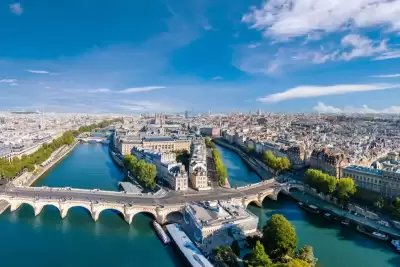
Île de la Cité is a historic island in the middle of the Seine River in Paris, the city's founding point, housing medieval structures like Notre-Dame Cathedral, Sainte-Chapelle, and the Conciergerie.
Île de la Cité is not only the geographical center of Paris but also its historical starting point. Inhabited by the Parisii tribe in the 3rd century BC, this island transformed into an urban center called Lutetia during the Roman period, laying the seeds for present-day Paris. This small piece of land, nestled between the two arms of the Seine River, gathered France's political, religious, and legal power under one roof for centuries.
The island's most famous structure, Notre-Dame Cathedral, underwent extensive restoration after the 2019 fire and reopened to visitors in 2024. To visit this cathedral, one of the most impressive examples of Gothic architecture, you need to purchase tickets in advance. Sainte-Chapelle, located nearby, is another distinct stop with its 13th-century stained-glass windows; the colorful light filtering in, especially on sunny days, is a sight to behold. The Conciergerie, part of the Palais de la Cité, was used as a prison during the French Revolution, and Marie Antoinette was held captive here.
We recommend allocating at least half a day to explore the island; for those who wish to visit Notre-Dame, Sainte-Chapelle, and the Conciergerie in detail, a full day is a more realistic plan. You can cross to the island by walking over Pont Neuf, then descend to the tip of Square du Vert-Galant to see both arms of the Seine simultaneously. Being on the island before it gets crowded, especially around Notre-Dame, ensures a much more comfortable visit.
Guide's Note

Best Time to Visit
The most suitable period to visit Île de la Cité is between April–May and September–October. During these months, the weather is mild, and the crowds remain much more manageable compared to the summer months. Keep in mind that in July and August, long queues form in front of Notre-Dame, and entry to Sainte-Chapelle can take hours.
The time of day is also a determining factor: if you are on the island right after opening, between 08:00–09:00, you can explore both Notre-Dame and Sainte-Chapelle almost empty. In the afternoon, tour groups fill the island. Visitor numbers decrease in winter; however, since you need natural light for Sainte-Chapelle's stained glass, the experience might be different on cloudy days.
How to Get to the Island
The Cité station on Metro Line 4 of the Paris Metro is directly on the island and is the most practical option. RER B and C lines also stop at Saint-Michel–Notre-Dame; this stop is within walking distance of Notre-Dame.
If you prefer walking, you can cross to the island from the banks of the Seine using the Pont Neuf or Pont Saint-Michel bridges. Since Pont Neuf is the oldest bridge in Paris, the crossing itself becomes a historical experience. For those using buses, lines 21, 38, 85, and 96 follow routes close to the island.
Suggested Visit Route
For those who want to explore the island efficiently, we suggest the following order: Start with Notre-Dame Cathedral and be there at opening. Then, walk a few minutes to Sainte-Chapelle; seeing the stained glass in the morning light offers a special pleasure. For lunch, descend to Square du Vert-Galant on the western tip of the island and relax with a view of the Seine.
In the afternoon, visit the Conciergerie; it's a must-see for those who want to feel the atmosphere of the French Revolution. You can complete the day by walking over Pont Neuf and browsing the bouquiniste (second-hand book seller) stalls along the Seine.
What to Eat on and Around the Island
Île de la Cité itself is not a major restaurant district; however, the Saint-Germain-des-Prés district immediately south of the island and the Marais district to its east are quite rich in dining options. There are a few cafes and sandwich shops on the island for daily needs.
Before leaving the island, be sure to try Berthillon ice cream; this legendary ice cream shop located on nearby Île Saint-Louis is considered among the best ice cream parlors in Paris. You can easily reach it by walking across the bridge connecting the two islands.
Photo Spots
If you want to frame Notre-Dame from across, use Pont de l'Archevêché or the pedestrian path on the left bank of the Seine. Compositions that place the river in the foreground with the cathedral in the background yield particularly good results in golden hour light.
Square du Vert-Galant is located at the tip of the island where the Seine splits into two, ideal for capturing both arms of the river in the same frame. The interior of Sainte-Chapelle, with its colorful play of light from the stained glass, is one of Paris's most unique venues for interior photography; a wide-angle lens will make your job easier.
Things to Pay Attention To
Notre-Dame reopened in 2024; however, restoration work may still be ongoing in some sections. We recommend checking the official website for the current status before your visit. Purchasing an online ticket for Sainte-Chapelle will significantly shorten your wait; during peak periods, waiting at the entrance can take hours.
Security checks (X-ray screening) are applied at all major structures on the island. Large bags and backpacks can extend this process. The island is quite crowded, so be careful of pickpockets; carry your valuables in front-pocket bags or inside pockets.
How Much Time to Allocate
For those who only want to explore from the outside and see Notre-Dame, 2–3 hours might be sufficient. If you also want to visit Sainte-Chapelle and the Conciergerie from the inside, planning a full day is more realistic. You might spend more time than expected inside both structures.
If you combine Île de la Cité with Île Saint-Louis, you'll add a relaxed pace to your day; walking between the two islands only takes a few minutes. Also, leave time for Berthillon ice cream and strolling through the quiet streets of Saint-Louis.
This content originates from neresigezilir.com.tr and may not be copied without permission.
FAQ
Updated: