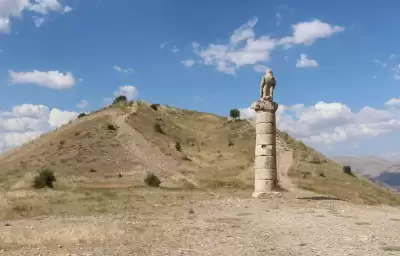
Karakuş Tumulus, located on the side of the Nemrut Mountain road in Adıyaman's Kahta district, is a monumental tomb built in the 1st century BC by King Mithridates II for his mother Isias; it is known for its conical structure with a 110-meter diameter and 21-meter height, and the eagle statue on its summit.
Located within the Nemrut Mountain National Park protection area, in the Kahta district of Adıyaman, the Karakuş Tumulus is one of the most important monumental tombs from the Commagene Kingdom period. This artificial mound, built in the 1st century BC by King Mithridates II for his mother Isias, presents a striking appearance on the flat terrain with its 110-meter diameter and approximately 21-meter height. The tumulus is covered with stones transported from the Kahta Stream and its conical shape makes it easily noticeable from a distance in its geographical location.
The tumulus's name comes from the eagle statue placed on top of a column to its south; Karakuş means black eagle in Turkish. Along with the surrounding columns and the statues on them, the tumulus is a unique reflection of Commagene art and royal cult. Its location on the route to Nemrut Mountain makes it easy for the majority of visitors to include this historical structure in their itineraries.
Guide's Note
Karakuş Tumulus attracts history enthusiasts as a monumental tomb from the Commagene Kingdom period. Visitors can feel the historical weight of the tumulus, with its columns and eagle figures, firsthand. The fact that it was built for the women of the royal family adds a unique meaning to the structure.
From a practical perspective, entry and parking are free; the area can be explored on foot in just a few minutes. There is a cafe at the entrance, and toilets are paid but the price is noted as reasonable. Its location on the Nemrut road makes it an easy stop to add to the itinerary for those already visiting the region. The night view is also shared to have a distinct charm.
Some visitors describe the area as a place that can be explored quickly, worth stopping by if it's on your way; however, they do not recommend planning a long journey specifically for this site.
- Environmental maintenance: More than one visitor points out that the area's surroundings are neglected.
- Lack of explanatory information: There is no hint in the comments about whether there is sufficient on-site information about the history and importance of the structure; it is recommended that those seeking information do research beforehand.
- Open area conditions: Since the tumulus is located in an open area, it may be useful to be prepared for windy weather.
What is Karakuş Tumulus?
Karakuş Tumulus is a monumental tomb complex belonging to the royal family of the Commagene Kingdom, especially its female members. It is known to have been built by King Mithridates II for his mother Isias. With a diameter of 110 meters and a height of 21 meters, it is one of the largest artificial mounds in the region, featuring a conical structure covered with stones transported from the Kahta Stream. When considered together with the surrounding columns and the statues on top of these columns, the structure is not just a tomb but also a royal monument.
The tumulus's name comes from the eagle statue placed on top of the southern column. In Commagene iconography, the eagle symbolizes divinity and royal power. For this reason, the structure is sometimes referred to by the public as the Monumental Tomb of Women.
Historical Background
The Commagene Kingdom, which ruled in Southeast Anatolia in the 1st century BC, was a unique civilization that blended Hellenic and Persian cultures. This kingdom, with its capital Samosata, built some of the most magnificent monuments of the period in these lands; the giant statues on Nemrut Mountain are the most well-known among them.
Karakuş Tumulus is also a product of the same tradition. King Mithridates II had this monument built for his mother Isias, thus honoring the female members of the royal family with a lasting monument. The inscriptions and reliefs around the tumulus offer important clues to researchers about the art and religious beliefs of the period.
When to Visit?
The most suitable periods to visit Karakuş Tumulus are April–May and September–October. During these periods, the weather is mild, the surroundings are covered with greenery, and the lighting conditions are very favorable for photography. In the summer months, temperatures in the Adıyaman region can exceed 40 degrees Celsius, so staying outdoors for long periods, especially at noon, can be tiring.
In winter months, access to the region can sometimes be difficult; the possibility of the Nemrut Mountain road being closed should also be considered. Early morning hours are both cool and quiet, making it an ideal time to visit for those who want to explore the tumulus away from the crowds.
How to Get There?
The tumulus is located approximately 10 km south of the Kahta district, which is part of Adıyaman province. Regular minibus services are available from Adıyaman city center to Kahta. After arriving in Kahta, you can reach the tumulus by taxi or private car.
To reach Adıyaman, you can use Adıyaman Airport; there are regular flights from Istanbul and Ankara. For those arriving by road, Adıyaman is easily accessible via Gaziantep and Şanlıurfa. If you are joining Nemrut Mountain tours, the tour itinerary most likely includes Karakuş Tumulus; therefore, choosing an organized tour can be both a practical and economical option.
Suggested Itinerary: Kahta and Surroundings
Karakuş Tumulus can be combined with other historical sites in its vicinity to create a full-day excursion. The suggested itinerary can be structured as follows:
Morning: Departure from Kahta and visit to Karakuş Tumulus. Walk around the tumulus, examine the columns and the eagle statue up close.
Before noon: Visit to the Ancient City of Arsameia, a few kilometers away. Reliefs and inscriptions from the Commagene period will also be found here.
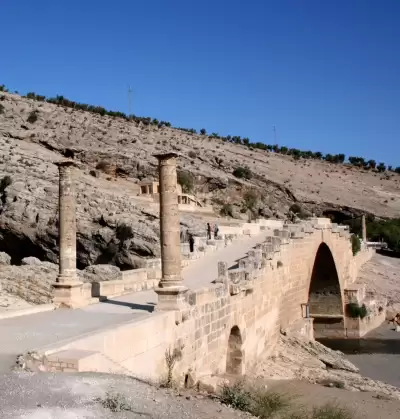
Afternoon: Visit to the historical Cendere Bridge; this Roman-era bridge is another important stop in the region.
Evening: Watching the sunset by climbing Nemrut Mountain forms the most unforgettable finale of this itinerary.
Photo Spots
Karakuş Tumulus offers several different shooting angles for photography enthusiasts. The column located to the south of the tumulus, with the eagle statue on its top, is one of the most preferred frames; in morning light or golden hour, this column creates a dramatic silhouette.
For those who want to frame the entire tumulus, shooting from a distance with a wide angle yields more effective results. The tumulus, combined with the surrounding flat terrain and the distant mountain silhouette, also offers a strong composition for panoramic photos. Those wishing to take aerial photos with a drone are advised to check national park rules beforehand.
Things to Know Before Visiting
Karakuş Tumulus is located within the Nemrut Mountain National Park protection area. During your visit, it is necessary to comply with national park rules, avoid damaging the historical site, and pay attention to the signs in the area.
Since the area is in open terrain, sun protection is essential in summer; a hat, sunglasses, and plenty of water should be with you. Choose comfortable and sturdy shoes as the ground may be uneven. Shaded areas around the tumulus are very limited. Also, since there are no dining or shopping facilities in the immediate vicinity, it is recommended to meet your needs before departing from Kahta.
This content originates from neresigezilir.com.tr and may not be copied without permission.
Karakuş Tumulus Videos
Karakuş Tumulus videos load when you open this section to keep the page fast.
Show videos
FAQ
Updated: