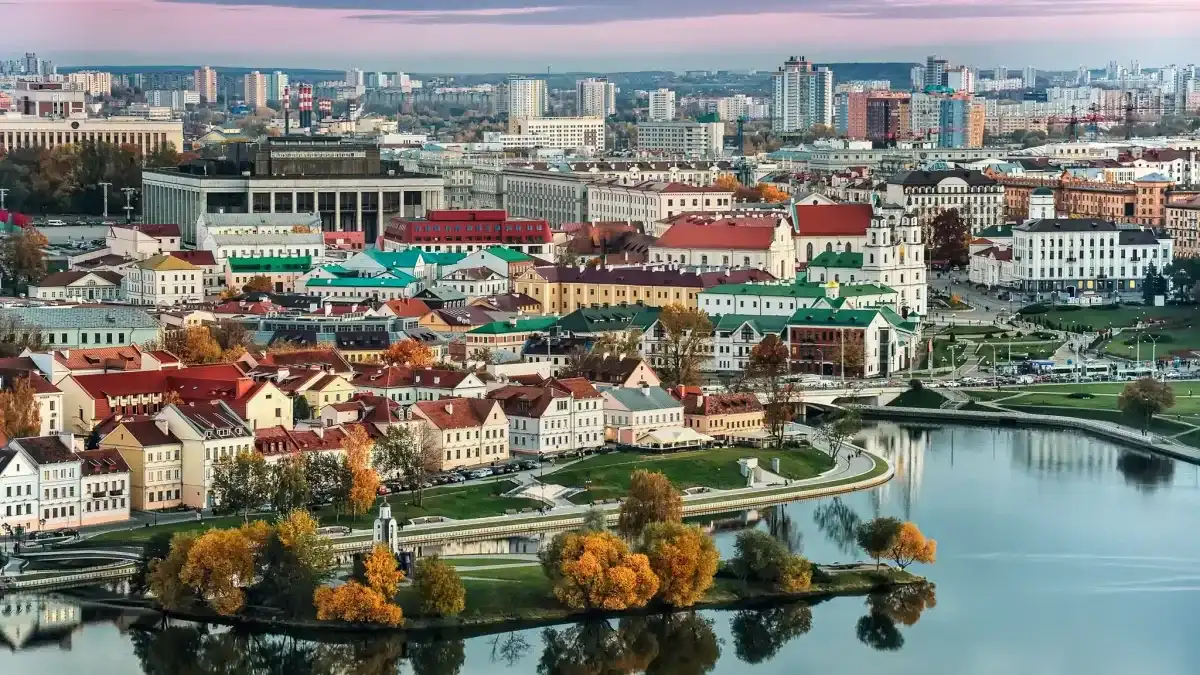
Belarus
The Republic of Belarus is a landlocked country located in the center of Eastern Europe. Gaining its independence with the dissolution of the Soviet Union in 1991, the country is characterized by a multi-layered history.…


When to Visit
The ideal period to visit Belarus is spring (May) and autumn (September-October). During these seasons, the weather is mild, the sky is clear, and walking around the city is pleasant. In summer, temperatures in Minsk hover around 25-28 degrees Celsius, and parks are full of life; however, crowds also increase. In winter (between -5 and -15 degrees Celsius), the cold can be intense, but it is enchanting for travelers seeking snowy landscapes.
If you want to experience city life and nature together, choose May. In early June, weekend festivals and outdoor events begin in Belarus. Between December and January, Christmas markets and New Year celebrations add a different atmosphere to the city.
How to Get There
Direct flights from Turkey to Belarus are not very common. Generally, flights from Istanbul, Ankara, or Izmir to Minsk National Airport are provided with a transfer via capital cities. The flight duration is approximately 4-6 hours. From the airport to Minsk city center, you can reach in 30-40 minutes by taxi, bus, or pre-arranged transfer services.
Visa-free entry is a great advantage for Turkish citizens: you can stay for 30 days within a 90-day period with a Turkish passport. However, international health insurance is mandatory and may be requested upon entry into the country. For travelers arriving by train and bus, routes via neighboring countries (Poland, Russia, Lithuania) are available.
Getting Around the City
City transportation in Minsk is cheap and efficient. The metro, buses, and trams are well-organized and clean. The metro is especially preferred as it connects the city center; tickets are very economical. Calling a taxi is also safe and affordable; you can use Yandex or local applications. Walking around the city center is safe, and exploring the historical areas this way is more enjoyable.
To visit castles and palaces outside the city (such as Mir Castle, Nesvizh Palace), there are organized tours or car rental options. Bus connections to these places from Minsk are available, but tour guides are more practical if time is limited.
How Many Days to Stay
To get to know Minsk well, at least 3-4 days are sufficient. During this time, you can visit the city's main squares, museums, Katolik Street, botanical garden, and green parks at a relaxed pace. The city is not very large, so the center can be visited very well within 4 days.
If you want to add historical centers like Mir Castle and Nesvizh Palace, a total of 5-7 days would be more suitable. If there are lesser-known towns and natural beauties of Belarus, a 10-day program is quite satisfying. There's no need to fear having too much time; Belarus combines man-made beauties with natural attractions.
Suggested Itinerary
Days 1-2: Start in Minsk. On the first day, go from the airport to your accommodation, and rest. On the second day, visit Independence Square, the Red Church, the National Library, and see the Mamayev monument. In the evenings, take a walk on Nemiga Street. Days 3-4: Explore Minsk Central Market, spend time in the Botanical Garden, visit museums (such as the Art Museum, History Museum). Day 5: Take a day trip to Mir Castle, and enjoy its medieval architecture. Day 6: Visit Nesvizh Palace and observe the old architecture of Nesvizh town.
If you have a longer program, you can also visit cultural centers such as the Brest Fortress, Churches in Orsha City, and Vitebsk. There is no need to rush during your trip to Belarus; it is much more enjoyable to absorb the atmosphere of each place at a slow pace.
Accommodation Options
Accommodation options in Minsk are varied and affordable. For budget travelers, hostels range from $10-20, mid-range hotels from $40-80, and luxury hotels are above $100. Locations near Minsk Central Market, Independence Square, and around Nemiga Street are strategic for exploring the city. Airbnb apartments are quite popular for travelers who want to experience local life.
If you want to visit Mir Castle or Nesvizh Palace, there are hotel and guesthouse options in those towns, but a day trip from Minsk is cheaper and more practical. Don't worry about safety during your stay in Minsk; the city offers an extremely safe and tourist-friendly atmosphere.
Food Culture
Belarusian cuisine is strongly influenced by Russian and Eastern European traditions. You must try local dishes such as Draniki (potato pancakes), Lula (stew with fresh vegetables), Kuliaga (historical pastry). Meat and potatoes are prominent; you might have some difficulty as a vegetarian, but there are alternatives in larger restaurants. You can find local dishes cheaply at Minsk Central Market.
Bok (beetroot soup), Borscht (cabbage soup), and various flour-based dishes are staple elements of Belarusian tables. The local pita-like Placinta, filled with cheese and berries, is very delicious. Restaurants are generally affordable; mid-range meal costs are around $10-15 per person. Kvas (fermented grain drink) and local beer are very good; don't forget to try them.
Shopping and Souvenirs
In Minsk, there are modern shopping malls (such as Minsk Arena, Reki Mall) and small antique shops in the old city area. For those interested in Belarusian musicians and artworks, you can buy crafts, wooden toys, enamel pins, and Soviet-era memorabilia. But the real shopping experience is at Minsk Central Market; here you can find locally produced stone and fabric products.
Matryoshka (Russian nesting dolls), Soviet collections, and handmade porcelain products are popular souvenirs from Belarus. You can also buy icon paintings through museums and art galleries. Linen clothing and embroidered textiles are beautiful examples of Belarusian craftsmanship. Shops in the center stay open until late in the evening; however, markets close early in the morning.
Budget Planning
Belarus is an affordable destination in Central Europe. Daily expenses per person vary as $40-60 (with economic options), $60-100 (mid-range comfortable living), and $100+ (luxury holiday). Accommodation usually takes 30-40 percent of the total budget. Food is quite cheap; a meal is between $3-8. Transportation tickets are very economical for minimalist budget travelers.
Museum entrance fees are around $2-5. Tours to Mir Castle or Nesvizh cost $30-50. Day tour guides are priced around $50-80. Health insurance (mandatory) varies between $50-200 per year. If a two-week solo trip with mid-range comfort is planned, $1500-2000 per person is a reasonable budget.
Things to Consider
There is not much to worry about in terms of safety in Belarus; the city is quite safe and crime rates are low. However, you may experience communication problems due to not knowing Russian and Belarusian; English speakers can be found in the city center but are less common in rural areas. Keep in mind that Google Maps may not be fully up-to-date in Belarus; you can download offline maps. Be sure to get health insurance (mandatory); it is a condition for entry into the country and may be requested.
You can buy mobile phone SIM cards at the airport, and internet is very cheap. The currency is the Belarusian Ruble; ATMs are common, but conversion may not be fast. The country may experience energy crises regarding gas and electricity (especially in winter months); this will not affect you. Stay informed about the political situation and be careful in sensitive areas; however, ordinary tourist areas are completely safe.
Photo Spots
In Minsk, Independence Square looks magnificent at sunset; its atmospheric lighting provides captivating photographic output. The futuristic architecture and interiors of the National Library can be visually impressively captured. Nemiga Street offers great diagonal photos with its street art and historic buildings. The crowded energy and color of Minsk Central Market are ideal for social documentary-style photography.
Mir Castle is perfect for a medieval atmosphere; especially photos taken in the early morning and at sunset look fairytale-like. The gardens and ponds of Nesvizh Palace are great for reflection photography. The Botanical Garden delights nature photographers. The Stelas (Republic Monument) and Martyrs' Square in the outer districts of Minsk are also major visual centers showing the city's history.
General Information
Belarus is a hidden gem of Eastern Europe and has been discovered by very few tourists. The country became independent after the dissolution of the Soviet Union in 1991. The capital, Minsk, was almost completely destroyed in World War II and was subsequently rebuilt with some of the finest examples of Soviet architecture. The country is landlocked and shares borders with Russia, Ukraine, Poland, Lithuania, and Latvia.
The population is approximately 9 million, and more than 2 million people live in the capital Minsk. The official languages are Belarusian and Russian; English has become common among young people but is limited among the elderly. The country's currency is the Belarusian Ruble (BYN). Travelers visiting Belarus experience a striking combination of modern comfort and historical heritage in Central Europe. This country is one of the still undiscovered corners of Europe.
This content originates from neresigezilir.com.tr and may not be copied without permission.
Places to Visit
No places found for this filter.