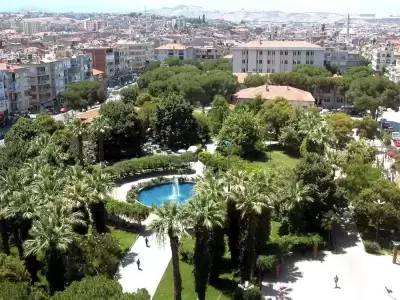
Thyateira Ancient City, located in the Akhisar district of Manisa, is an ancient city that dates back to the early Bronze Age and served as a trade and weaving center during the Roman period; it is an open-air archaeological site where history and faith tourism intersect, featuring colonnaded street ruins, basilica foundations, and housing one of the seven churches of Christianity.
Thyateira, nestled among modern buildings in the heart of Akhisar, actually represents one of the upper layers of a city thousands of years old. This ancient city, whose settlement history dates back to the early Bronze Age, became one of the most important trade and weaving centers of the region during the Roman period. Thanks to its strategic location at the intersection of major roads, it served as a critical junction both militarily and commercially. In 366 AD, during the civil war for the Roman throne, the forces of Procopius and Valens met right here; in this conflict, which went down in history as the "Battle of Thyateira," Valens' army was victorious and Procopius was executed.
The Roman-era colonnaded street, unearthed during excavations in the neighborhood known as "Tepe Mezarlığı" (Hill Cemetery) among the public, extends towards Hastane Höyüğü, the acropolis of the city. The phrase "Hekatontastylon," meaning the 100-Columned Structure, found in an inscription nearby, is thought to refer to this street. The visible part of the basilica today is approximately 10 meters wide and 43 meters long; however, its original dimensions are not fully known due to destruction. Thyateira also holds special importance for faith tourism as the site of one of the seven early Christian churches in the Aegean. It is stated that the museum card is valid for visitors; admission is free. Some visitors express that the area is not sufficiently promoted and that this historical texture in the city center deserves much more attention.
Related discoveries: Manisa places to visit, Historical Places, Manisa historical places, Emir Hıdır Bey Mosque.
Guide's Note

When to Visit?
Since the area is open-air, visiting in the scorching heat of mid-summer can be tiring. April-May and September-October are the most suitable periods for both weather conditions and light. Coming in the morning offers both a cooler environment and better light for photography. While it is possible to access the area in winter, entry to some sections may be restricted during excavation periods.
How to Get There?
Thyateira Ancient City is located in the Akhisar district center, on the İzmir-Istanbul highway (D565) route. It is approximately 90 km from İzmir and 70 km from Manisa city center. It is possible to reach Akhisar by buses that run frequently from İzmir or Manisa. After getting off at Akhisar terminal, you can reach the ancient site by walking or a short taxi ride. If you come by car, you can park in the district center car parks and walk.
How Much Time Should Be Allocated?
Thyateira is a compact area; 20-30 minutes is sufficient to comfortably see the ruins, the colonnaded street, and the basilica foundations. For those who want to take photos, read information panels, and examine the area more carefully, it can be extended up to 45 minutes. If you combine the visit with the Akhisar Museum, it makes sense to plan for a total of half a day.
Photo Spots
The most attractive photo spot in the area is the remains of the Roman-era colonnaded street. The arrangement of the column drums and the contrast created by the modern Akhisar buildings visible in the background create an interesting composition. To capture the general view of the basilica foundations, it is necessary to find a slightly elevated point. Morning light creates warmer tones on the stone surfaces.
What to Eat Nearby?
Akhisar is a district known for its olive and olive oil production. After your visit, you can find local breakfast, olive oil appetizers, and home-cooked meals at restaurants in the district center. Small patisseries and coffee houses in the bazaar are suitable for a short break.
Things to Pay Attention To
Since the area is in the city center and surrounded by dense construction, some of the ruins are in the shadow of buildings and in a relatively narrow area. Since the ground is uneven, prefer comfortable walking shoes. The number of staff in the area is limited; if you encounter any problems, note down the contact information of Akhisar Museum in advance. We recommend confirming visiting hours from official sources before you go.
Historical Importance of Thyateira
Thyateira, beyond being just an archaeological site, encompasses multiple historical layers. Starting from the Early Bronze Age and experiencing the Hellenistic, Roman, and Byzantine periods, the city is one of Anatolia's oldest continuously inhabited areas. During the Roman period, the city gained fame with its weaving guilds, becoming an important center for purple dye and fabric trade. It holds a special place in Christian history: the Church of Thyateira, one of the seven churches mentioned in the Book of Revelation, was located here. This feature makes the site a meaningful stop not only for archaeology enthusiasts but also for those traveling within the scope of faith tourism. The Battle of Thyateira in 366 AD leaves a concrete trace of the city's place in Roman internal politics.
Thyateira Ancient City Videos
Thyateira Ancient City videos load when you open this section to keep the page fast.
Show videos
FAQ

Updated: